






















U.S. Administration Faces Scrutiny Over Strikes on Alleged Drug Smugglers
The Trump administration is under intense scrutiny as officials continue their controversial campaign targeting small boats allegedly involved in drug smuggling from South America to the United States. Following accusations of executing crew members without trial, the White House’s inconsistent messaging regarding command authority raises concerns of potential legal repercussions for military personnel involved in these strikes.
Why It Matters
These military engagements have sparked a significant debate regarding the legality and ethics of using deadly force against individuals on civilian vessels. Some lawmakers question whether these actions violate U.S. and international laws, creating a precarious situation for servicemembers who may face prosecution for their involvement in the strikes.
Key Developments
- Defense Secretary’s Statement: Pete Hegseth confirmed he authorized the initial strikes against a small boat but distanced himself from subsequent attacks that resulted in the deaths of survivors.
- Congressional Concerns: Several members of Congress, including Rep. Adam Smith, have criticized Hegseth’s attempt to deflect responsibility, claiming it undermines military leadership and accountability.
- Legal Justifications Questioned: A memo from the Justice Department classifying the U.S. actions as part of a non-international armed conflict with drug cartels has drawn skepticism for its ambiguous and contradictory assertions about the nature of this conflict.
- Public Response: Critics, including human rights advocates, argue that such military actions constitute an unlawful act, not a legitimate wartime engagement, potentially setting a dangerous precedent for future military conduct.
Full Report
Conflicting Accounts from Officials
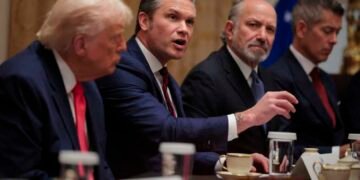
During a Cabinet meeting, Defense Secretary Pete Hegseth discussed his involvement in the military strikes, stating he observed the initial attack live but did not witness later strikes that claimed the lives of survivors from the damaged boat. He insisted that the decision to sink the boat came from Adm. Frank M. Bradley, a point that has drawn widespread condemnation from lawmakers such as Rep. Adam Smith, who accused Hegseth of avoiding accountability.
Legal Ramifications
The ambiguity surrounding the legal framework governing these strikes has alarmed many, including military legal experts. The justification provided by the Trump Justice Department framed the conflict as an armed engagement with drug cartels. However, critics argue that this classification contradicts itself, suggesting that the administration is wary of the implications of its own assertions.
Reactions from Congress
Admiral Bradley is expected to testify before Congress, where questions about the legality and ethics of the strikes are anticipated. As discussions unfold, critics assert that the administration’s approach undermines both military professionalism and safeguards designed to protect civilians in conflict zones.
Administration’s Defense
President Trump and Hegseth defended the military actions, claiming they targeted "narcoterrorists" and suggested the strikes significantly contribute to reducing drug trafficking in the U.S. However, these claims lack empirical support, with Sen. Rand Paul highlighting the alarming statistic that nearly 21% of Coast Guard drug interdictions yield no drugs, hinting at the possibility that many strikes might have been misdirected.
Inconsistent Messaging
Despite the president’s assertion of being informed about the strikes, he noted he was not aware of the specific details surrounding the second attack. This contradictory messaging from the administration has fueled further skepticism and concern among lawmakers and the public regarding the operational transparency of military actions.
Context & Previous Events
The administration’s military campaign began three months ago with an initial strike on a vessel in the Caribbean. The legality and ethics of using deadly force in such situations have led to an ongoing debate within military and governmental circles, highlighting the complex intersection of drug trafficking, national security, and international law.






