






















Violence Erupts in Bangladesh Following Death of Youth Leader
Violence has surged in Bangladesh after the assassination of Sharif Osman Hadi, a key figure in the youth movement that helped oust former Prime Minister Sheikh Hasina. Hadi, who was shot by masked assailants outside a mosque in Dhaka, succumbed to his injuries while being treated in Singapore. His death, which follows the announcement of the first elections since the uprising, has sparked widespread protests and unrest across the nation.
Why It Matters
The killing of Hadi has intensified political tensions in Bangladesh, a nation already grappling with the ramifications of a volatile political climate. His death raises alarming questions about election security and the potential for further violence as the country prepares for its upcoming elections. The situation underscores ongoing challenges related to democratic governance and civil liberties in Bangladesh.
Key Developments
- Sharif Osman Hadi was fatally shot outside a mosque in Dhaka and later died in Singapore.
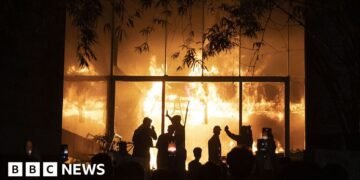
- His death has triggered mass protests, leading to attacks on the offices of prominent newspapers and the arson of one building.
- Firefighters and police intervened as demonstrators vandalized media outlets while hundreds gathered in protest.
- Nobel laureate Muhammad Yunus condemned the killing, calling it an “irreparable loss” and insinuating a conspiracy to derail forthcoming elections.
- The interim government has announced a national day of mourning and has declared several arrests in connection with the attack.
Full Report
Details of the Attack
On the day before Hadi’s death, local authorities revealed a date for the upcoming elections, a contest in which he had intended to run as an independent candidate. His assassination followed closely on this announcement, raising suspicions regarding the motivations behind the attack.
Reactions from Political Leaders
In the wake of Hadi’s passing, political figures across the spectrum have expressed their condolences. Muhammad Yunus, who leads the caretaker government, labeled the incident a “premeditated attack” aimed at disrupting the democratic process in the country. He reassured the public that violence intended to obstruct the elections would be met with zero tolerance.
Public Protests and Violence
As news of Hadi’s death spread, thousands of supporters converged in central Dhaka, resulting in clashes between demonstrators and law enforcement. Reports indicate that protestors vandalized the offices of The Daily Star and Prothom Ali, leading to significant property damage. Emergency responders had to rescue journalists from the affected buildings amidst the chaos.
Investigation and Ongoing Developments
Authorities have launched an investigation into the circumstances surrounding Hadi’s murder and have detained several individuals linked to the shooting. The interim government aims to bring those responsible to justice, emphasizing the critical need for stability as elections loom on the horizon.
Context & Previous Events
Hadi was a prominent leader within the student protest group Inqilab Mancha and an outspoken critic of India. His assassination marks a significant escalation in political violence following Sheikh Hasina’s departure to India amid widespread unrest last year. Shortly after her departure, Hasina faced a conviction for crimes against humanity related to her government’s handling of protests, resulting in a death sentence. The current political environment remains tense as the country approaches its first elections since these upheavals.