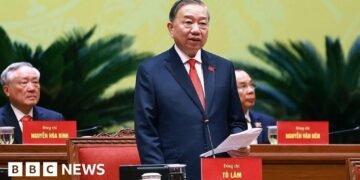























To Lam Re-elected as Vietnam’s Communist Party Chief Amid Calls for Economic Reform
In a significant political event, Vietnam’s Communist Party Congress has officially re-elected General Secretary To Lam to lead the party and the country for the next five years. This decision, made during a congress attended by approximately 1,600 delegates, marks a pivotal moment in Vietnam’s governance as To Lam emphasizes a new era centered on economic reform and national rejuvenation.
Why It Matters
To Lam’s reappointment signals both continuity and ambitious change in Vietnam’s political landscape. His leadership comes at a time when the country aims to transition from a state-dominated economy to one where the private sector plays a crucial role in driving growth. This shift is essential for breaking Vietnam’s potential stagnation and improving its competitive stance within Southeast Asia.
Key Developments
- Re-election of To Lam: Delegates at the Communist Party Congress re-elected To Lam as General Secretary on Friday, suggesting strong support for his leadership.
- Shift in Economic Focus: Under To Lam, Vietnam’s administration will prioritize private sector growth alongside state-owned enterprises, signaling a major shift in economic policy.
- Resolution 68: A pivotal policy change announced last year designates the private sector as a primary engine for economic growth, a historic move in Vietnam’s socialist context.
- Ambitious Economic Targets: Vietnam aims for double-digit economic growth, an expansion of the private business sector, and the rise of a knowledge-based economy by 2045, coinciding with its centenary of independence.
- Challenges with State-Owned Enterprises: Recent policy updates indicate pushback from conservative elements within the party favoring continued support for state-owned companies, complicating the implementation of reform.
Full Report
The Focus on Reform
Upon taking office 18 months ago, following the death of his predecessor Nguyen Phu Trong, To Lam initiated a sweeping reform agenda aimed at economic revitalization. This administration’s initiatives have included significant cuts to bureaucratic layers and an overall reduction in the number of government employees.
Resolution 68, a groundbreaking policy defined by To Lam’s administration, positions the private sector as the most vital component of Vietnam’s economic framework—a first for this officially socialist state. This marked a pivotal change that equates privately-owned businesses with state-run enterprises.
Aiming for Global Competitiveness
A crucial component of To Lam’s strategy involves nurturing "leading cranes," or large private entities that can compete globally, akin to Korea’s chaebols. The government aims to establish 20 globally competitive private companies by 2030. This ambition is underscored by Vietnam’s impressive economic transformation over the past three decades, pushing the country into the realm of manufacturing powerhouses.
However, as of 2024, state-owned enterprises continue to account for nearly 30% of the nation’s GDP, complicating the path for private companies to flourish. The recent passage of Resolution 79 emphasizes the potential for state-owned firms to also become leading competitors, indicating internal disagreement over the focus on privatization.
Industry Dependence
Despite significant advancements, many sectors in Vietnam still rely heavily on foreign investment and technology. Prominent companies such as Samsung exemplify the challenge as they dominate the market while depending on imported components. To Lam acknowledges the risks associated with this dependence, questioning the value generated within the country.
Vingroup as a Case Study
Vingroup, Vietnam’s largest private conglomerate, seeks to become a national champion but struggles in international markets, especially with its electric vehicle brand VinFast. While the company is finding local success, its global ambitions have faltered, raising questions about the viability of its strategies without significant reform and support.
Context & Previous Events
To Lam ascended to his leadership role following an extensive anti-corruption initiative led by his predecessor, creating a backdrop of both urgency and caution for reform. The ongoing rivalry within the party between different factions, notably between To Lam’s public security base and military allies, has been a longstanding source of political dynamic that will continue to influence Vietnam’s future.