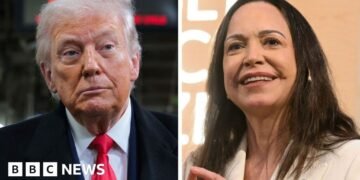























Venezuelan Opposition Leader María Corina Machado Prepares for Key Meeting with Trump
Venezuelan opposition leader María Corina Machado is set to meet with President Donald Trump at the White House, an encounter that could redefine her role in the country’s strained political landscape. The meeting is significant given the U.S. administration’s recent actions to undermine Nicolás Maduro’s regime, and it may influence who leads Venezuela during its ongoing political turmoil.
Why It Matters
Machado’s visit symbolizes a potential shift in U.S. foreign policy regarding Venezuela, highlighting the complexities of international endorsement in political movements. With Trump’s previous statements favoring Maduro’s vice-president, Delcy Rodríguez, the outcome of this meeting could determine whether Machado is positioned as a legitimate leader or sidelined in favor of a controversial figure. Public sentiment in Venezuela is divided, with many wary of U.S. involvement and the implications it could have for democracy.
Key Developments
- María Corina Machado will meet with President Trump at the White House on Thursday.
- Trump has expressed interest in Machado’s Nobel Peace Prize but noted the award cannot be transferred.
- Following a recent U.S. operation that ousted Maduro, Trump backed Rodríguez’s interim government, leading to a backlash from Machado and her supporters.
- The Venezuelan opposition is split over who should lead the country: Machado or Rodríguez.
- Machado previously garnered significant support in an opposition primary, which could bolster her claims to leadership.
Full Report
Meeting with Trump
Machado’s forthcoming meeting with Trump is seen as a crucial moment for her potential influence on U.S. policy in Venezuela. Historically, Trump has been unpredictable in his dealings with political figures, suggesting that Machado’s chances of gaining favor may depend on how Rodríguez behaves in the coming weeks. Machado aims to persuade Trump that trusting Rodríguez with the transitional government is a miscalculation, arguing that her opposition coalition is better suited to lead Venezuela towards democracy.
Trump’s Stance on Venezuela
Despite initially expressing disinterest in Machado, Trump recently praised Rodríguez as a "terrific person," following a long phone conversation. This support has convinced some opposition factions that Machado’s leadership is at risk of being overshadowed. Critics of the current U.S. strategy argue that this approach might not effectively restore democratic processes or address concerns for Venezuelan citizens.
Divided Perspectives
Opinions on Machado and Rodríguez are starkly polarized among Venezuelans. While Machado is hailed by many for her efforts to unify the fragmented opposition, she also faces significant resistance from Maduro’s loyalists. Polls indicate that public support for the government is waning, yet it still exerts control over key institutions, including the military and armed civilian groups known as colectivos. This complex power dynamic raises questions about the safety and feasibility of U.S. intervention, particularly regarding regime change without fresh elections.
Context & Previous Events
Earlier this month, U.S. operations successfully ousted Nicolás Maduro, leading to Trump’s endorsement of Rodríguez’s interim administration. Machado, who won a recent primary election with overwhelming support, was barred from running against Maduro. She has consistently aimed to challenge Maduro’s perceived illegitimacy and advocate for democratic governance in Venezuela. Nonetheless, the political landscape remains volatile, with many Venezuelans torn over U.S. involvement and the implications for their future.