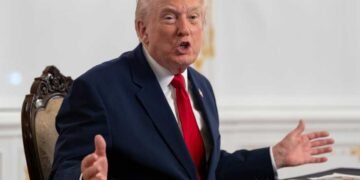























Trump’s Venezuela Airspace Closure Statement Triggers Backlash
President Donald Trump’s recent call to close the airspace above Venezuela has drawn sharp criticism from the Venezuelan government, which decries it as a violation of international law. The contentious remarks come amid increasing scrutiny of U.S. military operations in the region aimed at dismantling drug trafficking networks.
Why It Matters
This development underscores the escalating tensions between the U.S. and Venezuela, raising concerns about potential military engagement in the region. The situation highlights not only geopolitical implications but also domestic debates about the administration’s military authority and the legality of its actions.
Key Developments
- Trump announced via Truth Social that the airspace above Venezuela should be considered closed to various entities, including airlines and drug traffickers.
- The Venezuelan government quickly condemned Trump’s statement, labeling it a “colonialist threat” and asserting that no outside authority can dictate the use of its airspace.
- Despite Trump’s statement, flight trackers indicate that commercial aircraft continue to operate within Venezuelan airspace.
- The U.S. Senate and House Armed Services Committees have initiated investigations into military operations against suspected drug boats in the Caribbean, linking them to Trump’s broader strategy against drug trafficking.
- Democratic leaders have criticized military actions as lacking sufficient evidence and potentially constituting war crimes.
- Republican Senator Eric Schmitt defended Trump, suggesting that his approach falls within Article 2 powers concerning national security.
Full Report
Trump’s Controversial Comments
On Saturday, Trump took to Truth Social to declare, “To all Airlines, Pilots, Drug Dealers, and Human Traffickers, please consider THE AIRSPACE ABOVE AND SURROUNDING VENEZUELA TO BE CLOSED IN ITS ENTIRETY.” His remarks have been met with outrage from the Venezuelan government, which issued a statement emphasizing that Trump’s comments violate international law and undermine the country’s sovereignty.
Ongoing Military Actions
Simultaneously, the Pentagon is facing scrutiny following reports that Defense Secretary Pete Hegseth ordered lethal strikes against drug-smuggling vessels in the Caribbean. Congressional committees are investigating these military actions, particularly the legality and justification behind the operations conducted under “Operation Southern Spear.”
Political Reactions
Democratic Senator Chris Van Hollen remarked on the military’s actions, suggesting that they could be classified as war crimes due to the lack of presented evidence. Conversely, Republican Senator Eric Schmitt supported Trump’s stance, arguing that the administration’s actions target both drug cartels and the precursors coming from China.
Frustration among both parties is evident, with Senate Minority Leader Chuck Schumer criticizing Trump’s measures as reckless and indicative of a potential new foreign conflict. Representative Marjorie Taylor Greene, aligning herself with constitutional principles, reminded that Congress holds the exclusive power to declare war.
Context & Previous Events
Past military operations in the region have included a series of strikes on suspected drug-trafficking vessels, with at least 82 fatalities reported since the initiation of “Operation Southern Spear.” This military campaign has faced bipartisan criticism, particularly regarding the lack of Congressional approval for such international military engagements.






