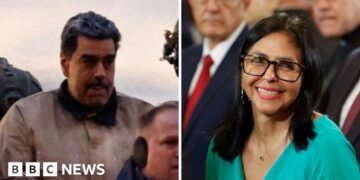























Delcy Rodriguez Sworn in as Venezuela’s Interim President Amid Growing Tensions
The political landscape in Venezuela is shifting dramatically as Delcy Rodriguez was sworn in as the country’s interim president during a parliamentary session that coincided with the U.S. custody of ousted leader Nicolas Maduro. Rodriguez, who has served as vice president since 2018, expressed her anguish over what she described as the "kidnapping" of Maduro and his wife, who were taken by U.S. forces during a recent raid.
Why It Matters
The swearing-in of Rodriguez marks a significant moment in Venezuela’s ongoing political crisis. The developments not only suggest a deepening rift between the U.S. and the Venezuelan government, but they also raise critical questions about international law, sovereignty, and geopolitical interests, particularly regarding Venezuela’s vast energy resources.
Key Developments
- Delcy Rodriguez officially became the interim president of Venezuela during a parliamentary session amid cries for the release of Nicolas Maduro from U.S. custody.
- Maduro pleaded not guilty to multiple charges, including drug trafficking and terrorism, during a hearing held in New York.
- The U.S. justified their raid on Maduro, labeling him a "fugitive from justice," amidst criticisms from the UN.
- Rodriguez indicated a willingness to collaborate with the U.S. for the mutual development of both nations.
- Thousands demonstrated in support of Maduro and Rodriguez, emphasizing national allegiance during this turbulent time.
Full Report
Court Hearing and Maduro’s Claims
Earlier in the day, Maduro appeared in a New York courtroom where he maintained that he is still the legitimate president of Venezuela. During this 30-minute hearing, he pleaded not guilty to four serious charges that include conspiracy related to narcotics and terrorism. Maduro proclaimed, "I’m a decent man. I am still president of my country," drawing significant attention both in and outside the courtroom. However, he was ultimately escorted from the room in shackles, under the watchful eyes of U.S. law enforcement.
U.S. Justification and UN Reactions
Following the court proceedings, U.S. officials faced sharp criticism at the United Nations. Venezuelan Ambassador Samuel Moncada criticized the U.S. action as an "illegitimate armed attack." In contrast, U.S. Ambassador Mike Waltz defended the operation, arguing it was a necessary enforcement action against an illegitimate regime. He described Maduro as a "fugitive from justice" and underscored that the U.S. could not allow the world’s largest energy reserves to remain under his control.
Rodriguez’s Statement and Public Support
In her acceptance speech to the National Assembly, Rodriguez expressed her pain over what she termed "illegitimate military aggression," vowing to prioritize peace and tranquility for the Venezuelan people. Her statement resonated with the thousands who gathered outside the Federal Legislative Palace in Caracas to show support for both her and Maduro’s family. Rodriguez also alluded to potential cooperation with the U.S., saying, “We invite the US government to collaborate with us on an agenda of cooperation oriented towards shared development within the framework of international law.”
Context & Previous Events
The unfolding events follow a weekend raid involving over 150 aircraft and 200 personnel sent by the U.S. into Venezuela to capture Maduro, who Trump previously described as someone the U.S. would "run" until a legitimate government could be established. As Rodriguez assumes the interim presidency, she is already facing threats from U.S. leadership, which suggests severe consequences if she fails to align with their expectations.