






















Venezuela Accuses U.S. of “Greatest Extortion” Over Seized Oil Tankers
Venezuela has condemned the United States during an emergency session of the UN Security Council, characterizing its recent actions concerning Venezuelan oil tankers as “the greatest extortion.” The Venezuelan ambassador to the UN criticized the U.S. seizure of two oil vessels as “worse than piracy,” escalating tensions between the two nations.
Why It Matters
The United States’ actions in the Caribbean, particularly regarding Venezuelan oil, have broader implications for international relations and security. As the U.S. ramps up military presence in the region, the accusations of illegal activities and extortion highlight the ongoing struggle for control and influence, affecting not just Venezuela, but the dynamics within Latin America and beyond.
Key Developments
- Venezuela accused the U.S. of acting outside international law at a UN Security Council session.
- Washington’s seizure of two oil tankers was labeled “looting” and “recolonization” by Venezuela’s UN envoy, Samuel Moncada.
- President Trump implemented a naval blockade on sanctioned oil tankers entering and leaving Venezuela.
- The U.S. has deployed 15,000 troops and various naval vessels to the Caribbean to combat drug trafficking.
- Russia and China criticized U.S. actions as bullying and warned of potential consequences for other nations.
Full Report
Emergency UN Session
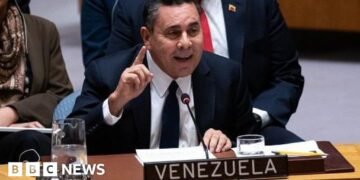
During the UN Security Council meeting, Venezuelan ambassador Samuel Moncada expressed outrage over the U.S. actions, claiming that they represent an unprecedented form of extortion. He argued that the seizure of oil tankers infringes on Venezuelan sovereignty, stating, “What does that have to do with drugs?” His remarks highlighted Venezuela’s position that the U.S. lacks jurisdiction in the Caribbean and is engaging in acts reminiscent of colonialism.
U.S. Promise of Continued Action
The U.S. has responded firmly, with Ambassador Michael Waltz asserting that Washington does not recognize Nicolás Maduro as Venezuela’s legitimate leader. He claimed that Maduro’s oil sales allow him to sustain his rule and engage in illicit activities.
Military Deployment and Justifications
As tensions escalate, the U.S. has mobilized troops and a variety of military vessels in the Caribbean, citing drug trafficking—and specifically the flow of fentanyl and cocaine—as a primary concern. This deployment marks one of the largest military mobilizations in the region since the 1989 invasion of Panama.
International Responses
The situation has drawn international criticism. Russia’s UN ambassador, Vassily Nebenzia, condemned the U.S. for “illegally destroying” civilian vessels, warning that such actions could set a dangerous precedent for other countries. China’s envoy, Sun Lei, urged the U.S. to halt its military actions and to seek de-escalation.
Context & Previous Events
Prior to the UN meeting, President Trump accused Maduro of leading a drug cartel and ordered a naval blockade of sanctioned oil tankers on December 16. The U.S. has targeted over 20 vessels in the region recently, claiming to combat drug traffickers.