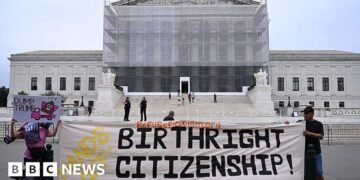























The Supreme Court to Review Birthright Citizenship for U.S. Children
The U.S. Supreme Court will hear a pivotal case concerning whether children born in the country to undocumented parents have a constitutional right to citizenship. This case poses significant ramifications for immigration policies and the broader definition of American citizenship.
Why It Matters
The outcome of this case could reshape the foundational principle of birthright citizenship enshrined in the 14th Amendment. As this legislative debate unfolds, it captures the attention of legal experts, political leaders, and communities impacted by immigration issues, highlighting the ongoing national conversation about citizenship and its implications for millions of families.
Key Developments
- The Supreme Court has agreed to hear a case challenging the executive order signed by President Trump aimed at ending birthright citizenship for children of undocumented immigrants.
- President Trump’s move faced multiple legal challenges, and lower courts blocked the implementation of his order.
- No date has been set for the Supreme Court’s arguments, with a ruling expected in the upcoming months.
- Cecillia Wang of the ACLU, representing the plaintiffs, argues that the 14th Amendment guarantees citizenship to all persons born on U.S. soil.
- The proposed changes could potentially increase the unauthorized population in the U.S. by millions over the coming decades, according to research studies.
Full Report
Supreme Court’s Involvement
The Supreme Court’s decision to hear this case follows numerous challenges to President Trump’s executive order, which aimed to strip citizenship from children born in the U.S. to parents who are in the country illegally or hold temporary visas. The administration contends that the 14th Amendment’s language regarding citizenship is not applicable to these groups. The legal discourse hinges on interpreting the clause “subject to the jurisdiction thereof” within the amendment.
Historical Context of the 14th Amendment
For nearly 160 years, the 14th Amendment has defined the citizenship status of individuals born on American soil, with limited exceptions for children of diplomatic personnel and military forces. Originally adopted in the wake of the Civil War to secure citizenship for freed slaves and their descendants, its interpretation has recently come under scrutiny.
Reactions from Civil Liberties Organizations
In a statement, Cecillia Wang, national legal director for the ACLU, asserted that the fundamental promise of citizenship cannot be altered by executive action. She emphasized the historical significance of the 14th Amendment as a long-standing law in American tradition, calling for clarity from the Supreme Court on this contentious issue.
Implications of Birthright Citizenship Repeal
A study by the Migration Policy Institute indicated that revoking birthright citizenship could lead to an increase of around 2.7 million additional unauthorized individuals in the U.S. by 2045, potentially growing to 5.4 million by 2075. The implications of such an increase would extend beyond demographics, directly affecting healthcare, education, and community services nationwide.
Context & Previous Events
In response to legal challenges against his executive order, multiple federal judges ruled that it violated the Constitution. However, in a favorable ruling for Trump, the Supreme Court later decided that lower court injunctions against his order had exceeded their authority, although they did not address the birthright citizenship issue itself. This case is part of the Trump administration’s broader immigration reform agenda, which is portrayed as addressing national security and public safety concerns.