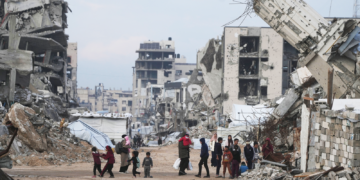























Trump’s Envoy Unveils Phase Two of Gaza Rebuilding Plan
Steve Witkoff, a special envoy under Donald Trump, has announced the initiation of phase two in the effort to resolve the ongoing conflict in Gaza. This new phase aims to disarm Hamas, facilitate the reconstruction of the war-torn region, and establish a governance panel comprised of Palestinian experts, all under U.S. supervision.
Why It Matters
This development is critical as it seeks to stabilize Gaza following two years of intense warfare. The successful implementation of this phase hinges on compliance from Hamas, as well as cooperation from Israeli authorities, which could significantly impact the long-term peace prospects in the region.
Key Developments
- The new governance group, named the National Committee for the Administration of Gaza (NCAG), will oversee daily operations in Gaza.
- The plan to disarm Hamas presents substantial challenges, with no detailed strategy on implementation.
- Witkoff has emphasized the necessity for Hamas to meet its obligations, including the repatriation of the last deceased Israeli hostage.
- While Hamas has faced criticism for not disarming, reports indicate that the Palestinian officials support the move to phase two.
- The U.S. has brokered a ceasefire deal and aims to establish a Board of Peace and peacekeeping forces as part of the second phase.
- International estimates suggest that reconstruction will cost over $50 billion, with minimal financial commitments secured thus far.
Full Report
In a recent announcement, Steve Witkoff revealed that the next steps following a U.S.-brokered ceasefire will address critical issues in Gaza. Under the proposed National Committee for the Administration of Gaza (NCAG), a group of Palestinian experts will manage the territory’s governance, although specific members have yet to be disclosed.
Witkoff underscored the obligation of Hamas to adhere to the ceasefire terms, particularly the must-retrieve remains of the last Israeli hostage. In a statement posted on social media platform X, he warned that failure to comply would result in “serious consequences.” This assertion highlights the high stakes involved as negotiations and transitions progress.
Mark Stone, a U.S. correspondent, noted that disarming Hamas represents a daunting task, as the group has not shown signs of relinquishing its weaponry. Additionally, the absence of clarity regarding the governance body’s composition adds layer of uncertainty to the transition process.
Despite the challenges, reports indicate that Palestinian leaders are supportive of advancing to phase two, which could help stabilize the region. The ceasefire, established under Trump’s 20-point plan, took effect in October, ceasing much of the hostilities that had erupted over the previous two years. However, multiple challenges have emerged since its implementation, including ongoing airstrikes from Israel and delays in reopening crucial border crossings.
Context & Previous Events
The current ceasefire was secured after two years of warfare between Israel and Hamas, which has left large areas of Gaza devastated. The complex situation continues to evolve as both sides accuse each other of breaches. The international community has placed significant pressure on both factions to ensure peace and rebuild the affected areas, which will require years of effort and substantial financial resources.