






















US Military Strikes Alleged Drug Smugglers, Raising Legal Concerns
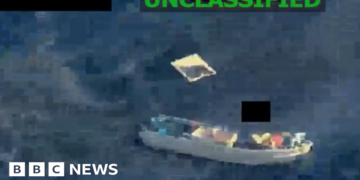
The U.S. military executed airstrikes on Wednesday, targeting two boats it claims were involved in drug trafficking, resulting in the deaths of five individuals aboard. This action marks the latest in a series of operations aimed at countering narcotics smuggling in the Caribbean and eastern Pacific, a mission that has raised questions over its legal framework and ethical implications.
Why It Matters
The recent strikes highlight the ongoing tensions in U.S. drug enforcement efforts, particularly as legal experts challenge the adherence of such military operations to international laws. With over 110 casualties reported since the offensive commenced in early September, the balancing act between national security and human rights is increasingly under scrutiny.
Key Developments
- Strike on Wednesday killed five people on two boats suspected of trafficking drugs.
- The strike occurred without clarity on its geographical location, though efforts are focused on narco-smuggling routes.
- Just a day earlier, a similar operation targeted three vessels identified as part of a trafficking convoy, leading to three additional fatalities.
- More than 30 strikes have been conducted under the Trump administration’s drug enforcement strategy, resulting in over 110 deaths.
- The legality of the “double-tap” strikes, where targeted boats were hit multiple times, has raised concerns among lawmakers.
- US Southern Command reported that survivors from the recent strikes are being actively sought, with eight individuals currently unaccounted for.
Full Report
Details of Recent Strikes
On Wednesday, U.S. Southern Command announced the strikes against two alleged drug trafficking boats, which resulted in five fatalities. While the exact location of these operations remains undisclosed, the command has emphasized a concerted effort over the past three months to target vessels believed to be engaging in narcotics transport.
The day prior, in a parallel operation, U.S. forces attacked what was described as a convoy of three narco-trafficking vessels, resulting in the deaths of at least three more individuals. During this operation, U.S. Southern Command acknowledged that some individuals survived, without specifying how many. Reports indicate that eight potential survivors were being sought, although their current status is unknown.
Concerns Over Engagement Rules
Legal experts have raised alarms regarding the framework of engagement surrounding these military actions. Critics argue the operations may infringe upon the laws governing non-international armed conflicts. Notably, a previous strike on September 2 drew particular scrutiny when it was revealed that survivors had been killed after a second strike targeted the same vessel.
U.S. Southern Command stated that the remaining personnel aboard the targeted vessels abandoned their crafts and were subsequently lost at sea. The officials did not specify the number of survivors following each operation but reiterated their confidence that the vessels were involved in narcotics-related activities, claiming intelligence substantiates these allegations.
Context & Previous Events
The current wave of military actions began on September 2, when U.S. forces executed the first strike in international waters. Since then, operations have intensified, with more than 30 strikes conducted targeting vessels deemed to be part of drug trafficking networks. These actions coincide with the Trump administration’s declared “war on drugs,” though the legal basis for employing military force in such a context is increasingly being questioned in political circles.