






















U.S. Military Seizes Oil Tanker Off Venezuela Coast
The U.S. military has successfully seized an oil tanker near the coast of Venezuela, marking a significant move in the Trump administration’s ongoing efforts to exert pressure on Nicolás Maduro’s regime. President Trump announced the operation, calling it a pivotal step in the campaign against the Venezuelan government, which the U.S. accuses of engaging in illicit activities, including drug trafficking.
Why It Matters
This operation underscores escalating tensions between the United States and Venezuela, particularly as both nations grapple over oil resources. With Venezuela holding some of the largest proven oil reserves globally, the seizure highlights Washington’s strategic interest in undermining Maduro’s government while raising concerns about the impact on global oil markets and geopolitical stability in the region.
Key Developments
- The U.S. seized a large oil tanker off Venezuela’s coast, identified by authorities as part of a sanctioned shipping network.
- Attorney General Pam Bondi confirmed the coordination of various agencies, including the FBI and the Coast Guard, in executing the operation.
- Venezuela condemned the act as “international piracy” and vowed to defend its sovereign rights to natural resources.
- The U.S. presence in the Caribbean has increased, with speculation about potential military actions against Venezuela.
- Oil prices rose following news of the seizure, igniting concerns about supply disruptions.
Full Report
Operation Details
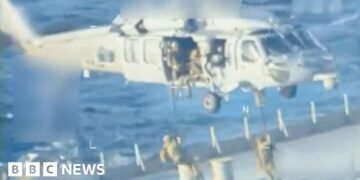
President Trump announced the seizure at a White House press briefing, stating, “We have just seized a tanker on the coast of Venezuela – a large tanker, very large, the largest one ever seized actually.” Attorney General Pam Bondi provided further details, labeling the vessel as a “crude oil tanker used to transport sanctioned oil from Venezuela and Iran.” A video of the operation depicted military helicopters hovering over the ship, with troops deploying onto the deck with weapons drawn.
A senior military official revealed that the operation involved a Department of War vessel, supported by helicopters, Coast Guard personnel, and Marines. Defence Secretary Pete Hegseth was said to be aware of the mission, which may indicate plans for similar actions in the future. When asked about the fate of the oil onboard, Trump casually remarked, “We keep it, I guess… I assume we’re going to keep the oil.”
Venezuelan Response
In reaction, the Venezuelan government issued a vehement statement denouncing the seizure as a “grave international crime,” asserting that Venezuela would not allow any outside power to strip its people of their rights to natural resources. Maduro remarked during a rally that Venezuela would never become an “oil colony,” while a senior government official labeled U.S. forces as “murderers, thieves, pirates.” He drew comparisons to the fictional character Jack Sparrow, asserting that while the character is portrayed as a hero, the U.S. actions represent high-seas criminality.
Military Build-up and Strategic Implications
The seizure came amidst an increased U.S. military presence in the Caribbean, which involved thousands of troops and the aircraft carrier USS Gerald Ford. According to reports, the U.S. has conducted over 20 naval strikes in the region since September, targeting vessels suspected of drug smuggling, with deadly consequences resulting from these operations.
Context & Previous Events
The Trump administration has intensified its campaign against the Maduro government in recent months, focusing on allegations of narcotics trafficking into the U.S. Venezuela, home to some of the world’s largest oil reserves, claims that the U.S. aims to exploit its oil resources. As the political and military standoff continues, both nations remain locked in a contentious struggle for influence and control over valuable natural resources.