


















U.S. Condemns Venezuela After Opposition Figure Dies in Custody
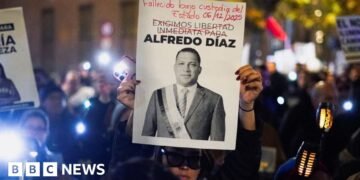
The United States has voiced strong condemnation of the Venezuelan government following the death of Alfredo Díaz, an opposition leader who had been detained for over a year. His passing in a Caracas prison cell has reignited accusations of human rights violations under President Nicolás Maduro’s administration.
Why It Matters
This incident underscores the escalating tensions between the U.S. and Venezuela amid a broader struggle for power and human rights in the region. The U.S. government’s response reflects deep concerns regarding the treatment of political prisoners and the ongoing humanitarian crisis in Venezuela, which have implications for regional stability and U.S. diplomatic efforts.
Key Developments
- Alfredo Díaz, 56, was reportedly found dead in El Helicoide prison, showing signs of a heart attack, according to Venezuelan authorities.
- The U.S. State Department labeled Díaz’s detainment as arbitrary and emphasized that he was held in a “torture centre.”
- Díaz was arrested after challenging the legitimacy of the presidential election results in 2024 that declared Maduro the winner.
- Concerns are mounting over the conditions faced by political prisoners in Venezuela, with at least 17 reported deaths since 2014.
- The opposition, including Democratic Action, has condemned the circumstances of Díaz’s death as unjust and indicative of deeper systemic issues.
Full Report
Reaction from the U.S.
The U.S. has criticized the Venezuelan government for the circumstances surrounding Díaz’s death, calling it a stark reminder of the perceived brutality of Maduro’s regime. The State Department’s Bureau of Western Hemisphere Affairs characterized Díaz’s detention as arbitrary, emphasizing that his imprisonment took place in what critics have termed a “torture centre.”
Political Context in Venezuela
Díaz was associated with the opposition and had served as governor of Nueva Esparta state. His arrest occurred amidst widespread allegations of electoral fraud during the 2024 presidential elections, which were condemned internationally. Despite official reports stating he succumbed to a heart attack, opposition groups argue that his death is part of a larger pattern of persecution against dissenting voices.
Opposition and Human Rights Concerns
Alfredo Romero, president of Venezuelan human rights organization Foro Penal, voiced concerns regarding the conditions for political prisoners, noting that Díaz was largely isolated during his time in detention, having seen his daughter only once. Prominent opposition leader María Corina Machado also spoke out, asserting that Díaz’s death fits a troubling trend related to government repression following the last election cycle.
Muddying Waters Between U.S. and Venezuela
The U.S. has ramped up its military presence in Latin America, partly in response to concerns over drug trafficking linked to Venezuelan leadership. President Trump has accused Maduro of leading a drug cartel and has threatened military action. Meanwhile, Maduro portrays U.S. policies as imperialistic maneuvers aimed at destabilizing his socialist government to take control of Venezuela’s oil resources.
Domestic Military Response
In an apparent show of strength, the Venezuelan army recently swore in over 5,600 soldiers, capitalizing on the increased military activity by the U.S. in the region. Venezuelan officials are also mending international ties, as evidenced by the recent agreement to resume Turkish Airlines flights, which had been suspended due to rising tensions.
Context & Previous Events
Alfredo Díaz’s detention followed the contentious 2024 presidential elections, where results declared Maduro the victor amid significant opposition allegations of fraud. International observers widely dismissed the elections as neither free nor fair, leading to widespread protests throughout the country. Since 2014, human rights organizations have documented the deaths of numerous political prisoners, raising ongoing alarms about the state of human rights in Venezuela.