






















US Accuses South Africa of Defying Orders to Expel Iranian Warships
The United States has publicly criticized South Africa for allegedly disregarding government orders to send Iranian warships out of its waters, marking a significant diplomatic rift. This controversy arises amidst growing tensions surrounding Iran’s involvement in regional military exercises while its government faces widespread protests against its regime.
Why It Matters
The accusations highlight not only the strained relations between the U.S. and South Africa but also raise questions about South Africa’s stance toward human rights issues globally. The backdrop of Iran’s internal strife adds complexity to South Africa’s foreign policy, particularly as it seeks to navigate alliances with both developing nations and Western powers.
Key Developments
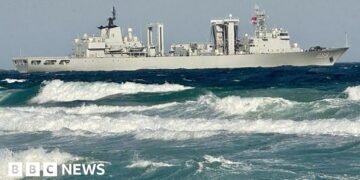
- The U.S. has accused South Africa’s defense ministry of failing to follow directives to expel Iranian warships conducting naval drills in its waters.
- A South African defense ministry spokesperson announced the commencement of an inquiry into the “serious allegations.”
- The U.S. embassy condemned the participation of Iranian forces, asserting it undermines regional stability amid Iran’s ongoing human rights violations.
- South Africa’s Defense Minister Angie Motshekga affirmed that President Cyril Ramaphosa’s orders were clear and intended to be upheld.
- The naval exercises, dubbed “Peace Resolve,” involve China and other Brics+ members, signaling a growing alliance among developing nations.
Full Report
U.S. Accusations
The U.S. government expressed serious concerns regarding South Africa’s defense ministry, alleging that it is not complying with orders to ask Iranian warships to leave its waters. The U.S. embassy issued a strong statement, emphasizing that actions supporting Iran contradict South Africa’s position on justice and human rights. The embassy pointed out the hypocrisy of South Africa’s government, which remains silent on protests in Iran while criticizing other regimes globally.
South Africa’s Response
In response to the allegations, South Africa’s defense ministry announced that it would investigate the situation to uncover the facts behind the claims. Defense Minister Angie Motshekga stated that Ramaphosa’s directives had been clearly communicated and that the orders should be strictly adhered to by all parties involved.
International Reactions
William Gumede, an associate professor at the University of Witwatersrand, underscored the irony of South Africa’s actions, noting the ongoing protests in Iran and the lack of support from the African National Congress (ANC) for the demonstrators. He described the situation as a series of democratic violations by the Iranian government, contrasting it with South Africa’s historical fight for justice.
Maritime Exercises
The naval drill, named “Peace Resolve,” initiated last Friday, is being led by China and includes nations from the Brics+ alliance, which consists of Brazil, Russia, India, China, and South Africa, along with new members like Egypt and the UAE. This coalition, aimed at strengthening the influence of developing countries, has been criticized in light of its engagement with a regime accused of severe human rights abuses.
Context & Previous Events
The Brics alliance, originally formed by Brazil, Russia, India, and China in 2006, expanded to include South Africa in 2010 and has since broadened to include several additional countries. The group seeks to challenge the dominance of Western powers in international affairs, now referred to as Brics+, particularly as it involves countries like Iran amid global scrutiny of their internal governance.