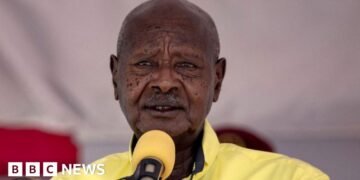























Uganda’s Museveni: A Life in Power Amidst Rising Opposition
Uganda’s long-serving president Yoweri Museveni, who has been in power since 1986, continues to face mounting criticism and pressure as he prepares for what many anticipate will be his sixth re-election campaign. The political landscape in Uganda is increasingly charged, particularly among the youth, who have only known Museveni as their leader.
Why It Matters
With over three-quarters of Uganda’s population under the age of 40, Museveni’s lengthy reign represents a pivotal moment in the nation’s history. As his government draws scrutiny for its increasingly authoritarian practices and the stifling of dissent, the upcoming election could either reaffirm his grip on power or signal a shift towards a more pluralistic political environment.
Key Developments
- Yoweri Museveni, 81, has been in power for nearly four decades, having assumed leadership after an armed uprising.
- Critics accuse him of consolidating power by sidelining opponents and undermining independent institutions.
- Constitutional amendments in 2005 and 2017 removed term limits and age restrictions for presidential candidates, which many believe are designed to pave the way for Museveni’s indefinite rule.
- Opposition figures like Kizza Besigye and Bobi Wine have faced significant governmental pushback, including arrests and intimidation.
- Museveni’s government has promoted foreign investment, aiming to transition Uganda into a middle-income nation by 2040.
Full Report
A Long-Standing Presidency
Yoweri Museveni’s journey began in 1944 in western Uganda, a period marked by significant political turmoil following the country’s independence from British colonial rule. He assumed the presidency in 1986 through a guerrilla campaign against then-president Milton Obote. Under Museveni’s leadership, Uganda experienced a relative economic resurgence, with consistent growth and improvements in education and health metrics.
Controversies and Criticism
Despite these achievements, Museveni’s tenure has not been without controversy. Allegations of human rights abuses and the suppression of political dissent have plagued his administration. His government’s alleged interference in the judiciary and media freedom has drawn international criticism and raised concerns about the country’s democratic integrity.
In 2021, during the campaign period, opposition leader Bobi Wine faced severe governmental backlash, including police violence against his supporters. Security forces have been accused of employing excessive force to quell dissent, with reports of unmarked vehicles abducting opposition members. Museveni’s rhetoric has echoed a commitment to maintaining order, including statements about the military’s readiness to uphold stability.
Responses from Supporters
While his critics are vocal, some Ugandans credit Museveni for sustaining stability and economic growth. His supporters point to the increase in foreign refugees finding asylum in Uganda as a testament to the country’s relative safety. Amid challenges, Museveni continues to position himself as an experienced leader capable of guiding the nation through turbulent times.
Context & Previous Events
Since the overthrow of Idi Amin in the late 1970s, Uganda’s political landscape has been tumultuous. Museveni initially emerged as a unifying figure following Amin’s brutal regime and the return of Milton Obote. Over the years, he has redefined the political framework of Uganda by altering constitutional provisions to secure his governance. Notably, the 2005 constitutional amendment eliminated presidential term limits, further cementing his power.
As Uganda approaches the next electoral cycle, the implications of Museveni’s extended rule remain a contentious topic that may shape the nation’s future and its quest for democratic governance.