






















U.S. Launches Major Strikes in Syria Following Deadly Attack on Troops
The Trump administration has initiated significant military strikes in Syria, targeting over 70 locations linked to the Islamic State (IS), in direct response to the recent ambush that resulted in the deaths of two U.S. soldiers and a civilian interpreter.
Why It Matters
This military action underscores the ongoing commitment of the U.S. to combat terrorism abroad while navigating complex geopolitical relationships. The strikes serve as a reminder of the persistent threats posed by extremist groups in the region and reflect the administration’s resolve to protect American personnel overseas.
Key Developments
- The U.S. conducted strikes on Friday, December 17, 2025, aimed at IS infrastructure in central Syria.
- Defense Secretary Pete Hegseth described the operation as a “declaration of vengeance” for the attack that killed U.S. personnel.
- The military response involved multiple aircraft, including F-15 and A-10 jets, and included the utilization of precision munitions.
- President Trump vowed serious retaliation against IS, emphasizing U.S. determination to defend American lives.
- The strikes targeted locations in Deir ez-Zor, Raqqa, and near Palmyra, reportedly hitting ISIS weapons storage and operational headquarters.
Full Report
Details of the Operation
In a coordinated military strike, the U.S. targeted 70 sites associated with the Islamic State as part of a response to the recent ambush that claimed the lives of Iowa National Guard soldiers Sgt. William Nathaniel Howard, 29, and Sgt. Edgar Brian Torres-Tovar, 25, along with civilian interpreter Ayad Mansoor Sakat. The attack occurred in eastern Syria, where these individuals were part of a coalition battling IS.
U.S. Central Command stated that the airstrikes involved over 100 precision munitions deployed from various aircraft, including F-15 Eagles, A-10s, and AH-64 Apaches. The operation showcased the U.S. military’s capabilities and commitment to countering terrorism.
President’s Statements
President Trump held a speech in North Carolina, labeling the strikes as a decisive response against what he termed "ISIS thugs." He reaffirmed the U.S. alliance with Syrian President Ahmad al-Sharaa, suggesting that Syria supports the U.S. efforts in combatting IS.
In a strong warning directed at IS, Trump issued a public statement asserting that any future threats to American personnel would result in severe consequences.
Syrian Response
In the wake of the strikes, Syria’s foreign ministry released a statement highlighting the need for international cooperation to counter terrorism. The ministry reiterated Syria’s commitment to combatting IS and stated that the operations would continue aggressively against any group posing a threat.
Reports indicated that the strikes affected rural areas of Deir ez-Zor and Raqqa provinces, striking at ISIS facilities identified as supporting the group’s operational capabilities.
Background on the Incident
The deadly attack on U.S. personnel occurred when an individual, previously affiliated with Syria’s internal security forces, opened fire during a joint meeting among U.S. and Syrian officials, resulting in additional casualties. The shooter was killed during the incident, which has heightened scrutiny over security protocols in the region.
Tributes to Fallen Soldiers
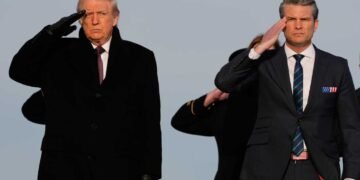
In a somber ceremony, President Trump met with the families of the fallen at Dover Air Force Base, honoring their sacrifice in a manner reserved for military funerals. The loss of these brave individuals has reignited discussions about the role of U.S. forces in Syria and the ongoing challenges in the region.
Context & Previous Events
This operation marks a pivotal moment in U.S.-Syria relations, which have evolved since the ouster of Bashar Assad a year prior. The U.S. has been reallocating military resources, focusing more on issues like drug smuggling in the Western Hemisphere while still addressing threats posed by ISIS in the Middle East. The ambush leading to the recent strikes underscores the volatile conditions still prevalent in Syria and the challenges faced by coalition forces operating in the area.






