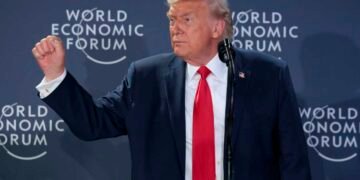

























Diplomatic Turbulence at Davos: Trump’s Remarks Stir Global Concerns
A series of controversial statements from President Trump during the World Economic Forum in Davos, Switzerland, have raised alarms among America’s allies and financial markets, highlighting anxieties over the United States’ role in global leadership. With tensions between the U.S. and its partners escalating over topics like tariffs and territorial disputes, the fallout from Trump’s remarks is significant.
Why It Matters
The recent events at Davos signify a potential pivot in global dynamics, challenging long-standing alliances and the post-World War II order. As middle-sized nations voice concerns over their security, the implications of U.S. unpredictability could reshape international relations and economic collaborations. Leaders from countries like Canada and Ukraine are worried not only about military stability but also about the erosion of established economic frameworks.
Key Developments
- President Trump’s off-the-cuff remarks regarding a potential U.S. military takeover of Greenland and resulting tariffs against European nations unsettled diplomatic relations.
- Canadian Prime Minister Mark Carney characterized the current global landscape as a "rupture," expressing fear for middle powers like Canada amidst growing geopolitical tensions.
- French President Emmanuel Macron echoed these sentiments, identifying a decline in the rules-based international order and the emergence of a world driven by power rather than diplomacy.
- During his address, Trump emphasized the necessity of military and economic strength, while attempting to clarify his position on Greenland, ruling out an invasion but continuing to question Denmark’s management of the territory.
- NATO Secretary-General Mark Rutte intervened to ease tensions, even as Denmark’s leadership distanced itself from Trump’s remarks.
- President Trump later issued a revocation of Canada’s invitation to participate in his newly proposed Board of Peace, aimed at addressing conflicts like that in Gaza.
- Ukrainian President Volodymyr Zelenskyy articulated frustrations about Europe’s hesitance to take decisive action, amid ongoing threats posed by Russia.
Full Report
Diplomatic Uncertainty
Davos witnessed escalated diplomatic friction, primarily instigated by President Trump’s impromptu comments. The remarks, which suggested a military presence in Greenland, led to heightened scrutiny and concern among U.S. allies, culminating in threats of new tariffs directed at several European nations. This unpredictability has forced allies to reassess the reliability of American commitments.
Reactions from Global Leaders
At the forum, Prime Minister Carney of Canada highlighted a concerning trend, stating, "We are in the midst of a rupture, not a transition," signaling fears about the potential collapse of the post-war economic and security frameworks. He cautioned that the stability previously provided by the U.S. is diminishing, requiring countries to navigate a new reality.
French President Macron cautioned about "instability" and a return to geopolitical confrontations. His remarks underscored a broader democratic retreat, implying that the current climate might jeopardize established international laws.
Trump’s Address
During his address, Trump argued for a perspective focused on raw military and economic strength rather than verbal reassurances. He voiced a desire for strong European allies while mentioning Greenland’s strategic importance. Following his speech, he appeared to step back from the idea of invading Greenland but still questioned Denmark’s oversight of the territory.
Overall Ambiguity
Following Trump’s declaration of an agreement on Arctic security, which lacked details, diplomatic confusion persisted. Denmark’s officials later clarified that Rutte’s comments did not represent their position, further complicating the U.S. administration’s standing in Europe. The week ended without resolution, leaving many wondering whether these upheavals are fleeting or signal a more fundamental shift in global leadership.
Context & Previous Events
In recent months, the U.S. administration has been characterized by unpredictable rhetoric and actions, leading to increased skepticism among allies regarding American reliability. This week’s events at the World Economic Forum underscore these trends, raising concerns about the sustainability of U.S. foreign policy and the future of international alliances. The historical framework that once provided stability in global relations appears increasingly fragile.