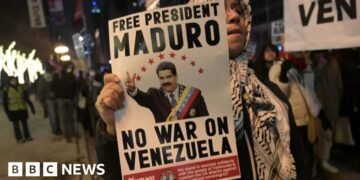























Nicolás Maduro Faces Court After Controversial U.S. Operation
In a dramatic turn of events, Nicolás Maduro, the Venezuelan president, arrived in New York City early Monday, escorted by armed federal agents after being detained in a Brooklyn jail overnight. This unprecedented operation, which saw the U.S. forcibly bring Maduro to face drug trafficking charges, raises significant questions regarding international law and U.S. sovereignty.
Why It Matters
This case is not just a legal battle; it represents escalating tensions between the U.S. and Venezuela. The implications of the operation challenge international legal norms and could set a troubling precedent for future U.S. interventions abroad.
Key Developments
- Nicolás Maduro has been indicted on drug trafficking charges, accused of facilitating the transport of cocaine to the U.S.
- The Trump administration justifies the operation as a necessary law enforcement action against a leader implicated in “narco-terrorism.”
- Experts express that the U.S. may have violated international law by extricating Maduro without United Nations approval or a legitimate international agreement.
- Maduro entered a not guilty plea in court on Monday, with plans to challenge the legality of his detention and extradition procedures.
- The 1989 U.S. intervention in Panama serves as a historical point of reference but has faced scrutiny regarding its legality under international law.
Full Report
Controversial Detention
Nicolás Maduro made his first appearance in a Manhattan courtroom Monday after being forcibly removed from Venezuela in a military operation that has raised eyebrows among international law experts. Attorney General Pam Bondi characterized the action as necessary to bring Maduro to justice, asserting that U.S. personnel acted under established legal protocols.
The Trump administration has labeled Maduro’s administration as engaged in “narco-terrorism,” alleging he has played a key role in drug trafficking operations. Bondi emphasized that the actions were part of a larger strategy addressing the regional drug crisis that has spurred violence and claimed American lives.
Legal Scrutiny
Despite these assertions, the legality of the U.S. operation faces significant scrutiny. Experts argue that the action contravenes international law, which prohibits the use of military force against other sovereign states without explicit UN Security Council approval. The operation also blurs the lines between law enforcement and military action, raising questions about the U.S. Constitution’s interpretation concerning the president’s military authority.
Maduro’s Response
During his court appearance, Maduro pled not guilty to the charges against him. His legal team is poised to challenge the legitimacy of the method used to bring him to the U.S., arguing that any indictment carried out under such circumstances violates international statutes.
Context & Previous Events
Maduro has faced indictment in the U.S. since 2020 for alleged drug trafficking. Furthermore, investigations by UN officials have criticized his leadership in Venezuela, citing crimes against humanity attributed to his government. Historically, the U.S. has taken similar actions, such as the 1989 operation to remove Manuel Noriega from Panama, which has also generated debate over adherence to international law.