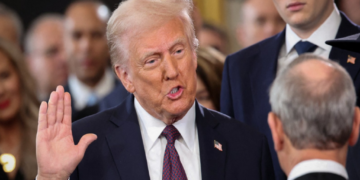























A Year of Transformations: Trump’s Unorthodox Presidency and International Implications
In the year since President Donald Trump’s second inauguration, his administration has navigated uncharted waters, challenging long-held political norms. With a resolute declaration that “nothing will stand in our way” at the inauguration, observers wonder if the world fully grasped the implications of his assertive approach, particularly regarding U.S. foreign policy and international relations.
Why It Matters
Trump’s presidency continues to redefine America’s role on the world stage, polarizing allies and igniting fears of an increasingly aggressive approach toward territory and allies. His rhetoric surrounding regions of strategic interest, such as Greenland, raises questions about the future of diplomacy and international agreements formulated since World War II.
Key Developments
- Trump’s rhetoric has shifted from notions of “manifest destiny” to outright claims over strategic territories like Greenland.
- His administration’s actions have led to concerns over a potential trade war and the integrity of NATO.
- Some congressional figures, like Rep. Randy Fine, have introduced legislation supporting ideas of annexation.
- European leaders, including French President Emmanuel Macron, voiced their concerns about the decline of international legal norms.
- Trump’s unpredictability has forced allies to adapt their diplomatic strategies, balancing respect with caution.
Full Report
A Shift in Diplomacy
On January 20, 2025, Trump began his second term with a warning that has reverberated globally: the U.S. would pursue its interests with unprecedented fervor. The invocation of “manifest destiny” during his inauguration speech signaled an aggressive posture. The focus shifted swiftly from historic territories to contemporary goals, notably Greenland, with Trump expressing an urgent need to claim the strategically vital land.
French President Macron underscored this new reality at the Davos Economic Forum, cautioning that Trump’s governance represents a move toward a lawless international order. The prospect of a muscle-flexing trade war and threats to NATO’s unity are increasingly serious considerations among global leaders wary of an America that appears ready to operate independently of established norms.
As Trump’s defenders stand behind the "America First" doctrine, some lawmakers have proposed legislation like the “Greenland Annexation and Statehood Act.” Rep. Fine’s comments about the UN only exacerbated concerns over international law’s relevance under the current administration.
Concerns from Allies
The disarray among international alliances has prompted varied responses. Some leaders have adopted a cautious strategy, advocating for dialogue while wrestling with the unpredictable actions of Trump’s administration. The mantra “take him seriously but not literally” has emerged as a coping mechanism among diplomats.
At times, Trump’s foreign policy reflects tendencies of both isolationism and interventionism, leaving allies unsure of how best to engage. Secretary of State Marco Rubio has attempted to clarify Trump’s negotiations around Greenland, framing them as an exploration of purchase rather than outright invasion.
Economic Implications
The ramifications of Trump’s foreign policy extend to economic realms as well. European leaders have begun preparing countermeasures in response to potential U.S. tariffs, and discussions surrounding market access have intensified. Italian Prime Minister Giorgia Meloni has hinted at misunderstandings, aiming to bridge gaps while maintaining a strategic bond with the U.S.
Context & Previous Events
Since Trump’s first term, his style has drawn parallels to real estate negotiations, often framed in terms of deal-making tactics from his business background. The unraveling of established diplomatic norms has resulted in a landscape where long-time alliances are being tested.
Trump’s assertion of military options, combined with a dismissal of traditional partnerships, remains a significant point of tension. Diplomatic leaders are grappling with navigating a new era defined by Trump’s brand of governance, shifting back and forth between aggressive posturing and attempts at maintaining stability in global affairs. The forthcoming international reactions pose unanswered questions about the future of U.S. foreign relations as allies prepare for a world reordered by Trump’s political ambitions.