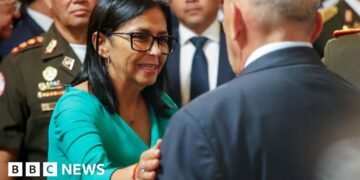























In a surprising turn of events, Delcy Rodríguez has been named the interim president of Venezuela following the ousting of Nicolás Maduro. This shift, characterized by U.S. officials as a move toward stabilization, raises critical questions about governance and the future of democracy in the nation.
The implications of Rodríguez’s appointment extend far beyond Venezuela’s borders. With the Trump administration’s endorsement, her leadership may signal a strategic pivot for U.S. policy in Latin America, prioritizing stability over a democratic transition, which could have profound effects on the region’s political landscape.
– **Rodríguez’s Background**: Formerly a deputy under Maduro and the daughter of a Marxist guerrilla, she embodies a continuation of the Chavista regime.
– **U.S. Support**: President Trump described Rodríguez as “gracious,” while dismissing opposition leader María Corina Machado, who many believe won the 2024 elections.
– **US Strategy**: Analysts indicate a preference for maintaining the existing regime’s structure, as a complete overhaul could lead to instability and violence.
– **Challenges Ahead**: Despite U.S. intentions, rebuilding Venezuela’s economy and infrastructure poses significant hurdles.
Rodríguez’s Rise to Power
Delcy Rodríguez’s installment as interim president has sparked intrigue, particularly among U.S. officials. Her ascent has been met with skepticism regarding its impact on Venezuelan democracy. Former U.S. ambassador to Venezuela, Charles Shapiro, noted that the Trump administration seems to favor stability provided by the existing regime over the unpredictability of supporting the opposition, specifically Machado.
Trump’s Position
President Trump surprised many by declassifying Machado as a respected figure within Venezuela, citing her lack of national standing. This view contrasts with a report from the Wall Street Journal, which highlighted a U.S. intelligence assessment suggesting that figures like Rodríguez were better positioned to lead a transitional government.
Concerns Over Stability
Analysts warn that the potential for violence remains high in a post-Maduro scenario. A report from the International Crisis Group (ICG) had previously cautioned Washington against drastic changes, emphasizing the risks involved. Phil Gunson, a senior analyst with the ICG, argued that significant power still resides with Maduro’s loyalists, complicating any transition.
Future Prospects
While Rodríguez may appeal to the U.S. for economic reforms and foreign investment, achieving a democratic transition appears increasingly challenging. U.S. Secretary of State Marco Rubio has laid out a three-phase plan that begins with stabilizing the country, but the administration has not clarified its long-term vision for democratic governance in Venezuela.
Venezuela has been mired in political turmoil, particularly since the 2013 death of former dictator Hugo Chávez, who named Maduro as his successor. The recent upheaval comes as Maduro has faced increasing international pressure and domestic unrest, culminating in calls for regime change and a need for reconstruction from decades of mismanagement.