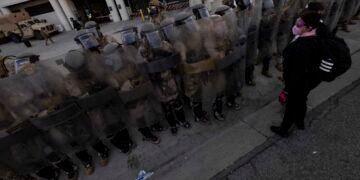























Trump Halts National Guard Deployments Amid Legal Challenges
President Trump has decided to pause his administration’s efforts to deploy National Guard troops to high-profile cities such as Chicago, Los Angeles, and Portland, Oregon, following a series of legal setbacks. The move comes as federal judges in these Democratic-led cities question the legality of military intervention in civilian matters, raising concerns over the separation of powers.
Why It Matters
The halt in troop deployment underscores the ongoing tensions between federal authority and state governance, particularly in areas with Democratic leadership. As crime rates and public safety become focal points in political discourse, the implications of this ruling could shape future strategies for addressing urban crime and federal interventions.
Key Developments
- President Trump announced a temporary shutdown of National Guard troop deployments to several cities.
- The Supreme Court recently ruled against an emergency appeal to send troops to Chicago, marking a crucial judicial intervention.
- Legal challenges continue to affect troop presence in other cities, including Washington, D.C.
- Republican-led states have welcomed National Guard deployments, with troops recently dispatched to Tennessee and Louisiana.
Full Report
Trump’s Announcement
In a post on Truth Social, Trump praised previous deployments, asserting they helped reduce crime in cities like Portland, Los Angeles, and Chicago. He claimed that without federal intervention, these areas would have faced significant safety issues. However, the reality on the ground has shifted as federal judges have increasingly scrutinized his administration’s actions.
Legal Setbacks
The Supreme Court’s recent decision came after lower courts had already blocked deployments in Chicago and Portland due to constitutional concerns regarding military engagement in civilian affairs. Judge Karin Immergut of the U.S. District Court pointed to the necessity of respecting foundational liberties outlined in the Constitution when ruling against Trump’s plans in Portland.
Ongoing Deployments
Despite the legal challenges to deployments in certain cities, Trump has continued to send National Guard troops to others, including over 2,000 in Washington, D.C. While a federal appeals court has allowed those troops to remain, their legality remains under examination by judges. In contrast, Republican governors in states like Tennessee and Louisiana have expressed support, with Louisiana Gov. Jeff Landry deploying 350 troops to New Orleans shortly after the Supreme Court ruling.
Future Implications
In his social media statement, Trump hinted at the possibility of returning with a stronger deployment strategy should crime rates rise again. His comments reflect an ongoing belief in the necessity of federal intervention in urban crime scenarios, a view that continues to divide lawmakers and the public.
Context & Previous Events
The attempts to deploy National Guard troops emerged following heightened concerns over crime rates in cities governed by Democrats. Trump’s administration had framed these deployments as essential for maintaining public safety and supporting federal immigration efforts. However, pushback from state leaders and the judiciary has severely limited these initiatives, prompting a reevaluation of the administration’s strategies moving forward.






