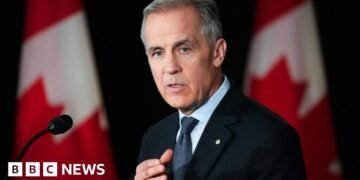























Trump Withdraws Invitation to Canada for ‘Board of Peace’
US President Donald Trump has rescinded an invitation for Canada to join his newly established ‘Board of Peace,’ amid escalating tensions between the two North American allies. The move comes after Canadian Prime Minister Mark Carney cautioned about a potential fracturing of the US-led global order during a recent speech at the World Economic Forum.
Why It Matters
The withdrawal illustrates ongoing frictions between the US and Canada, particularly concerning Trump’s foreign policy initiatives. The ‘Board of Peace’ is positioned as a new entity for resolving international conflicts, specifically aimed at addressing the crisis in Gaza. However, the lack of a definitive UN endorsement raises concerns regarding its legitimacy and effectiveness.
Key Developments
- Trump announced the withdrawal on Truth Social, addressing Carney’s office but providing no explanation for the decision.
- Canada signaled it would accept the invitation on the condition of not paying a $1 billion membership fee.
- The ‘Board of Peace’ is designed to address the conflict between Israel and Hamas, yet its charter notably omits any mention of the Palestinian territories.
- So far, 35 out of 60 invited nations, including countries like Argentina and Turkey, have agreed to join, while major UN Security Council members have not committed.
- EU leaders, including European Council President Antonio Costa, expressed skepticism about the board’s charter but are open to collaboration on a Gaza peace plan.
- Carney faced Trump’s criticism after his World Economic Forum speech, which urged "middle powers" to unite against economic coercion from larger nations.
Full Report
Withdrawal of Invitation
Trump’s announcement, made on Thursday, marks a notable shift in US-Canada relations. In his post, the president did not elaborate on his reasoning for revoking Canada’s invite, leaving Prime Minister Carney’s office without immediate comment. Carney had previously indicated support for joining the board, contingent upon Canada not having to pay the substantial membership fee.
Character of the ‘Board of Peace’
The ‘Board of Peace’ is framed as a new international organization aiming to mediate conflicts worldwide. Trump, serving as the board’s chairman, will hold significant decision-making authority. However, the proposed charter has raised eyebrows due to its lack of references to the Palestinian territories in the context of the ongoing violence in Gaza.
International Reception
While about 35 nations have committed to joining, the absence of participation from key UN Security Council members—including China, Russia, France, and the UK—casts doubt on the board’s potential influence. France has specifically called the board’s charter "incompatible" with its international obligations, raising questions about its legitimacy.
Discontent from Europe
After an EU leaders’ summit, Costa acknowledged the doubts among European leaders regarding the board’s governance, scope, and alignment with the UN Charter. Despite these concerns, he affirmed a willingness to work with the US on a unified approach to peace in Gaza, highlighting the EU’s complex relationship with the newly launched entity.
Trump and Carney’s Exchange
Tensions between the two leaders escalated following Carney’s standing ovation speech in Davos, where he emphasized the need for middle powers to assert themselves. Trump retorted by implying that Canada benefits from US support, stating, “Canada lives because of the United States.” In response, Carney clarified that Canada does not merely survive due to its relationship with the US but thrives as an independent nation.
Context & Previous Events
Recent developments in US-Canada relations have been marked by fluctuations in diplomatic discourse. Carney’s warning about the potential disintegration of the US-led global order reflects broader concerns shared by several countries about the shifting dynamics of international relations under Trump’s administration. Additionally, the initial invitation to join the ‘Board of Peace’ came after Canadian leaders expressed interest in participating, although the high membership fee posed a barrier.