






















Trump Doubles Down on Greenland Acquisition, NATO Raises Concerns
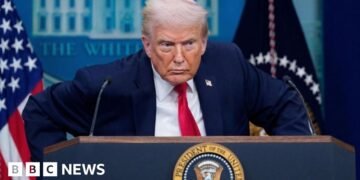
The U.S. President Donald Trump has intensified his campaign to acquire Greenland, declaring it "imperative" and suggesting that negotiations could reshape international alliances, including NATO. During a press briefing at the White House, Trump indicated a willingness to assert control over the territory, prompting questions about the potential implications for U.S. relationships with allies.
Why It Matters
This escalating situation emphasizes the fragility of international alliances as Trump’s administration appears ready to prioritize territorial ambitions over established partnerships. As leaders from NATO and the European Union express concerns regarding the stability of global governance, Trump’s stance raises questions about the future of diplomatic relationships and collective defense agreements.
Key Developments
- Trump reaffirmed his commitment to Greenland during a news conference, stating there is "no going back" on his position.
- In response to a BBC inquiry, the president claimed he has done more for NATO than any other leader but questioned the alliance’s willingness to support the U.S. in times of need.
- Greenland’s minister, Naaja Nathanielsen, expressed bewilderment at Trump’s demands, seeking respect for their sovereignty and cultural identity.
- European leaders, including French President Emmanuel Macron and European Commission President Ursula von der Leyen, criticized Trump’s tactics and affirmed support for Greenland’s autonomy.
- Trump threatened tariffs on European goods as a means to influence discussions surrounding Greenland and NATO.
Full Report
Trump’s Greenland Position
During a news conference, President Trump underscored his view of Greenland as "imperative" to U.S. interests, asserting a lack of intention to backtrack on his previous comments about acquisition. He hinted at the seriousness of negotiations, stating, "You’ll find out" when pressed about how far he would go.
NATO’s Future in Question
In the same breath, Trump remarked on NATO, claiming credit for its strengthening while expressing reservations about the alliance’s loyalty in a crisis. He articulated doubt over whether NATO members would equally support the U.S. if needed, saying, "I just really do question whether or not they’ll come to ours."
Reactions from International Leaders
The responses from international leaders highlight growing unease regarding Trump’s approach. Macron cautioned against a "shift towards a world without rules," urging respect and adherence to lawful conduct rather than coercive tactics. Meanwhile, von der Leyen emphasized the EU’s commitment to Arctic security and reiterated that Greenland’s sovereignty is "non-negotiable."
Greenland’s Minister of Industry and Natural Resources voiced the territory’s discontent with U.S. overtures, stressing their desire for autonomy and the importance of cultural preservation. "We do not want to be Americans," Nathanielsen stated, making clear the local sentiment against being treated as mere political leverage.
Economic Pressures
Further complicating matters, Trump proposed imposing tariffs on European goods should nations oppose his Greenland initiative. The president specifically mentioned a potential 10% tariff on imports from eight European countries, warning of escalated economic tensions. Macron has already labeled these tariff threats as "fundamentally unacceptable," advocating for a unified EU response.
Context & Previous Events
The North Atlantic Treaty Organization (NATO), founded with 12 member states, operates under a principle of collective defense outlined in Article 5, which states that an attack on one member is treated as an attack on all. The current geopolitical climate has seen increasing tensions, with leaders from Canada and the EU affirming their support for Greenland and the Kingdom of Denmark against any coercive attempts by the U.S.
Trump’s recent comments come amid broader discussions at the World Economic Forum, where global leaders are grappling with questions about international governance and the potential for an evolving global order.