






















Tensions Rise as Trump Signals Possible Military Action Over Iran Protests
The ongoing protests in Iran have escalated tensions between the U.S. and Tehran, as President Donald Trump suggests military action could still be on the table amid claims that violence against demonstrators is subsiding. Despite Trump’s optimistic statements about halting executions, the situation remains precarious, with reports of a crackdown on anti-government activists.
Why It Matters
This development comes at a time when the Iranian regime struggles to maintain control amidst widespread dissent over economic hardships and governance issues. As international reactions unfold, the actions of the Trump administration could significantly impact diplomatic relations and regional stability.
Key Developments
- Trump asserts that reports indicate the cessation of executions in Iran, but he leaves military action on the table.
- The U.S. and U.K. have started to diminish their presence at the Al-Udeid air base in Qatar as a precautionary measure.
- Iran’s airspace was briefly closed, leading multiple airlines to reroute flights around the country.
- British and American embassies have adjusted their operations, with the British embassy temporarily closed.
- The Iranian Foreign Minister asserts that executions are not imminent, countering earlier threats.
- Tips from "important sources" have led the U.S. to believe that violence against protesters may have decreased.
Full Report
Trump’s Remarks and U.S. Position
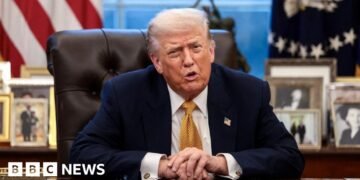
From the White House, Trump commented on intelligence that suggested a decline in violence in Iran, citing conversations with unidentified sources. He articulated recent fears within his administration over potential executions of detained protesters, specifically referencing a 26-year-old man who was reportedly sentenced to death during protests against the government.
Trump’s earlier rhetoric hinted at "very strong action" should the Iranian government proceed with executing protesters. The case of Erfan Soltani, whose execution was purportedly postponed, has amplified scrutiny of Iran’s response to dissent.
International Reactions
In response to increasing tensions, the Foreign Office in the U.K. has stated that its embassy operations in Tehran will shift to a remote format. The U.S. embassy in Doha is cautioning personnel and citizens to avoid unnecessary travel to military installations. Additional countries, including Italy and Poland, have advised their citizens to evacuate Iran, while Germany has suggested airlines refrain from entering Iranian airspace.
Military Precautions
The U.S. and U.K. are taking strategic measures by reducing personnel numbers at the Al-Udeid air base, showing a shift in military readiness. This facility, housing around 10,000 U.S. personnel and 100 U.K. staff, serves as a crucial hub in the region.
Ongoing Domestic Crackdown
The Iranian government has intensified its crackdown on protests, implementing an internet blackout in efforts to stem dissent. Amnesty International corroborated escalating violence, asserting that 2,435 demonstrators have been killed thus far, including children. The Human Rights Activists News Agency reports that an additional 882 fatalities are under investigation, complicating the already dire human rights situation in the country.
Context & Previous Events
The unrest initially sparked in December due to the plummeting value of Iran’s currency, rapidly evolving into a broader challenge to the legitimacy of the clerical regime. U.S. military responses have been a concern since an attack on Iranian nuclear sites in June 2025, reflecting a tense backdrop against which current developments are playing out.
As the situation progresses, it remains to be seen how the U.S. will balance its military posture with diplomatic channels in seeking to influence events in Iran.