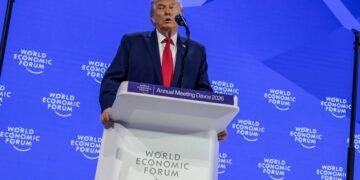























Donald Trump made headlines while addressing the World Economic Forum in Davos, focusing on U.S. relations with Greenland and Europe during a speech that lasted over 70 minutes. His comments, particularly regarding military intervention and international trade, sparked significant discussions among leaders and media alike.
The significance of Trump’s remarks lies in his stance on U.S. foreign policy and relationships with longtime allies. By discussing military power, economic policies, and European energy production, Trump is framing the U.S.’s role on the global stage in a manner that could impact diplomatic and economic relations.
Key Developments
- Trump stated that the U.S. “won’t use force” in relation to acquiring Greenland, a departure from previous aggressive rhetoric.
- He emphasized the U.S. role in World War II, claiming that without American intervention, “you’d all be speaking German.”
- The president criticized NATO, arguing that the U.S. contributes far more than it receives, calling the situation “very unfair.”
- Trump threatened tariffs on several European countries if they continue to oppose U.S. interests in Greenland.
- Addressing energy policies, he criticized the UK for not better utilizing its North Sea resources.
- In an unusual interjection, he commented on French President Emmanuel Macron’s eyewear, creating light-hearted moments amidst serious topics.
Full Report
Remarks on Greenland
During his speech, Trump made headlines by proclaiming that the U.S. would not resort to military action to acquire Greenland. This marked a notable shift in his messaging, as he highlighted that using excessive force would be unnecessary. He asserted, “I don’t have to use force, I don’t want to use force, I won’t use force,” dispelling any notions of military intervention.
Historical Context
Throughout his address, Trump repeatedly referenced World War II, asserting that American forces played a crucial role in defending Greenland from German occupation. He expressed regret at the decision to return Greenland to Denmark post-war, labeling it as an act of ungratefulness from the nation he believes benefited from U.S. protection.
Criticism of NATO
Trump voiced his longstanding criticisms of NATO, claiming the United States is treated unfairly by the alliance. He stated, “We give so much and we get so little in return,” emphasizing his belief that his previous administration had significantly strengthened NATO, contrasting it with his current grievances.
Tariff Threats and Energy Policies
The president indicated that tariffs could be implemented against European countries defending Denmark’s claims over Greenland, suggesting a 10% tariff effective February 1 that could rise to 25% by June if negotiations to purchase Greenland fail. He portrayed this stance as non-destructive, claiming a desire to cooperate with European nations.
Trump turned his attention to the UK’s energy policies, criticizing what he described as the government’s failure to effectively exploit North Sea reserves, leading to skyrocketing energy prices. He remarked that the UK produces only one-third of its energy outputs from all sources compared to 1999.
Light-hearted Exchanges
Amid his serious assertions, Trump took a moment to joke about French President Emmanuel Macron’s choice of sunglasses during his speech, highlighting the lighter side of international diplomacy. Despite previously criticized comments about Macron, Trump concluded by stating he actually likes the French leader.
Context & Previous Events
This Davos speech came in the wake of Trump’s ongoing efforts to negotiate with Denmark regarding Greenland, which he expressed interest in purchasing. Recently, NATO had faced scrutiny regarding its funding and collective defense effectiveness, often a point of contention for Trump.






