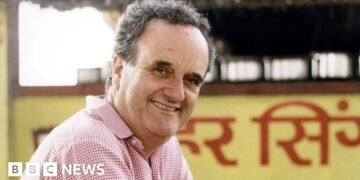























Tributes Pour in for Veteran BBC Journalist Sir Mark Tully
Sir Mark Tully, the esteemed BBC journalist revered as the "voice of India," was cremated in Delhi on Monday, a day after passing away at the age of 90. His death has sparked an outpouring of tributes from colleagues, admirers, and political leaders who recognized his significant contributions to journalism over several decades.
Why It Matters
Tully’s pioneering work as a foreign correspondent defined much of the narrative surrounding South Asia’s historical events. His unique ability to connect with the Indian populace and represent their stories has left a lasting impact on journalism in the region. His passing marks the end of an era in foreign reporting, underscoring the role of journalism in shaping public consciousness.
Key Developments
- Sir Mark Tully passed away on Sunday at a Delhi hospital, where he had been receiving treatment.
- Hundreds gathered at the Lodhi crematorium in Delhi, including family, friends, and former colleagues, to pay their respects.
- Prime Minister Narendra Modi hailed Tully as a “towering voice of journalism,” reflecting on his deep connection to India.
- Colleagues shared personal anecdotes, highlighting Tully’s influence on their lives and the media landscape in India.
Full Report
Mourners assembled at the Lodhi crematorium to bid farewell, where Sir Mark’s body was adorned with fresh flowers and garlands. Christian priests recited prayers, and hymns were sung in remembrance of the notable journalist, whose reporting was instrumental during significant historical moments in India and beyond.
Described as a "chronicler of modern India," Tully reported on key events such as the 1984 anti-Sikh riots, the birth of Bangladesh, and military transitions in Pakistan. During the tumultuous early 1990s, he faced significant risks while covering the demolition of the Babri mosque, showcasing his commitment to truth even amid danger.
Colleague Satish Jacob reminisced about their 48-year friendship, recalling a delightful moment post-1983 Cricket World Cup, where Tully was joyfully celebrating in the streets. Author William Dalrymple recognized Tully as a “giant among journalists,” commending his courage and commitment to telling uncomfortable truths.
Prominent figures across India, including political scientists and veteran journalists, reflected on Tully’s profound influence. Political analyst Pratap Bhanu Mehta stated that Tully’s broadcasts served as the sole credible voice during crises, particularly in the coverage of the 1984 riots. Veteran journalist Coomi Kapoor added that he was the most trusted voice in India, surpassing government-controlled alternatives.
An anecdote from journalist Shekhar Gupta captured the public’s reliance on Tully’s reports, illustrating how the BBC confirmed pivotal historical events that shaped national beliefs.
Born in Calcutta in 1935, Sir Mark Tully spent most of his life in India. He was honored with knighthood in 2002 and received India’s prestigious Padma Shri and Padma Bhushan awards—rare accolades for a foreign national.
Context & Previous Events
Tully’s career was marked by his coverage of several defining moments in South Asian history, including the storming of the Sikh Golden Temple and the Soviet invasion of Afghanistan. His reporting became synonymous with the events of his time, making him a fixture in global journalism. His influence grew particularly during periods when reliable reporting was scarce, and the voices of foreign correspondents were crucial in informing the world.