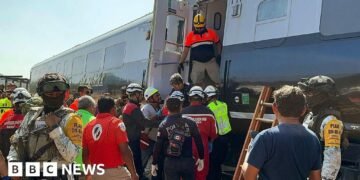























Train Derailment in Mexico Claims Lives and Injures Many
At least 13 individuals lost their lives and nearly 100 others sustained injuries following a train derailment in southwestern Mexico’s Oaxaca region, according to the Mexican navy. The incident occurred as the train was navigating a curve near the town of Nizanda, raising serious safety concerns regarding the country’s rail system.
Why It Matters
This tragedy highlights the urgent need for rigorous safety protocols in Mexico’s railway infrastructure, especially as the government pushes to modernize the rail system. The incident calls into question the effectiveness of these developments, which are aimed at promoting economic growth in the region through enhanced freight and passenger services.
Key Developments
- Thirteen fatalities confirmed and 98 injuries reported.
- Among the injured, 36 are receiving hospital treatment, with five in serious condition.
- The train was en route from the Gulf of Mexico to the Pacific Ocean when it derailed.
- Mexico’s Attorney General has launched an investigation into the accident.
- High-ranking officials, including the Secretary of the Navy, are heading to the crash site.
- The train, part of the Interoceanic route, connects Salina Cruz on the Pacific with Coatzacoalcos on the Gulf Coast.
Full Report
The derailment involved a train that was carrying 241 passengers along with nine crew members. Rescuers were seen assisting survivors from the tilted train, which had partially fallen off a cliff. Photos captured during the event illustrated the chaotic scene as aid workers sprang into action.
Mexican President Claudia Sheinbaum remarked on the seriousness of the situation, noting that five of the injured passengers are in critical condition. The Governor of Oaxaca, Salomón Jara Cruz, expressed profound sorrow over the incident, reaffirming that state authorities are collaborating with federal agencies to support those affected.
The Interoceanic train service, inaugurated two years ago under former President Andrés Manuel López Obrador, was designed to revitalize the region’s economy by creating a strategic trade corridor. Enhanced infrastructure aims to modernize transportation across the Isthmus of Tehuantepec and bolster industrial and port facilities. However, the recent derailment raises questions about the safety measures in place for these ambitious projects.
Context & Previous Events
The Interoceanic rail link was introduced to stimulate economic growth across southern Mexico, an area previously underserved in terms of transportation infrastructure. The government’s ongoing efforts focus on expanding both passenger and freight rail services to facilitate trade and development in the region.