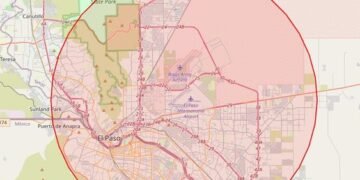























El Paso International Airport has been directed to suspend all flights for a duration of 10 days due to “special security reasons,” as indicated by a recent Notice to Airmen (NOTAM) issued by the FAA. This unprecedented measure marks the first extensive airspace closure over a significant U.S. city since the September 11 attacks.
The closure holds considerable implications for air travel and regional security, affecting both civilian and military operations within its designated no-fly zone. With safety on high alert, the FAA’s actions reflect a robust response to potential threats within the U.S. airspace, raising questions about security protocols and future air travel stability.
Key Developments
- The FAA has established a no-fly zone around El Paso International Airport, impacting all flights until February 21 at 6:30 AM UTC.
- The designated airspace stretches 10 nautical miles from the airport and reaches heights up to 18,000 feet.
- Affected flights include commercial airlines, military aircraft, and emergency services helicopters.
- The FAA warns that non-compliance could result in law enforcement intervention, including possible use of “deadly force” against perceived threats.
Full Report
Order Details
The restriction applies to all incoming and outgoing flights at El Paso International Airport, which is located approximately four miles from the Mexican border. However, the order does not extend to Mexican airspace. This closure is particularly significant as more than four million passengers utilized the airport in 2024, primarily for domestic travel within the U.S.
Statements from Officials
Vincent Perez, a Texas House Representative for El Paso, characterized the move as unprecedented, noting, “I have never heard of an American airspace being shut down for 10 days, absent a major emergency.” Such comments highlight the unusual nature of this directive, which impacts multiple sectors including commercial, military, and emergency medical services.
Impact on Pilots
The FAA has explicitly prohibited any aircraft operations within the parameters outlined in the NOTAM, emphasizing the need for compliance amid heightened security measures. A source familiar with the situation added that virtually no aircraft, regardless of type, are permitted to operate in the designated airspace.
Context & Previous Events
This airspace restriction marks the first substantial closure over a major U.S. city since the aftermath of the September 11, 2001 attacks, a period when national security protocols were redefined. The measure underscores ongoing concerns regarding air safety and defense preparedness in the face of potential threats to aviation security.






