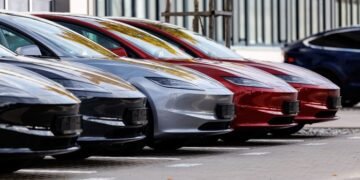























Tesla Cedes Title of World’s Top Electric Vehicle Maker Amid Sales Decline
Tesla has relinquished its position as the leading manufacturer of electric vehicles globally, facing challenges including increased competition and uncertainty surrounding CEO Elon Musk’s political involvement. The company’s sales dipped for the second consecutive year, highlighting evolving market dynamics.
Why It Matters
This shift in the market landscape not only reflects intensified competition, particularly from Chinese automakers, but also raises questions about Tesla’s future strategy and leadership direction. As consumer preferences evolve and competition heats up, Tesla’s ability to innovate and respond could significantly impact its standing in the industry.
Key Developments
- Tesla delivered 1.64 million vehicles in 2025, marking a 9% decrease from 2024.
- Chinese competitor BYD sold 2.26 million vehicles last year, taking the title of the largest EV manufacturer.
- In the fourth quarter, Tesla’s sales were 418,227, falling short of analyst expectations of 440,000.
- The end of a $7,500 tax credit potentially affected Tesla’s sales figures.
- Stock gained approximately 11% over the year, with shares trading around $450.27 recently.
- New, lower-priced versions of the Model Y and Model 3 aim to attract more customers.
- Analysts are projecting a 3% decrease in sales and a nearly 40% drop in earnings per share for the upcoming quarter.
Full Report
Tesla’s sales performance has declined significantly, delivering only 1.64 million electric vehicles in 2025, a figure that reflects a 9% decrease compared to the previous year. This trend has been partly attributed to the company’s struggle against increasing competition from international players, most notably BYD, which surged ahead with 2.26 million vehicle sales.
In the final quarter of the year, Tesla’s delivery numbers fell short of analyst forecasts, delivering 418,227 vehicles against an expected 440,000. Some analysts believe that the recent expiration of a $7,500 federal tax credit could have hindered sales during this period, contributing to the overall decline.
Despite the disappointing sales figures, Tesla’s stock experienced an 11% increase throughout the year, indicating investor optimism about the company’s future. As Musk continues to pursue ambitious projects like robotaxi services and humanoid robots, shares rose nearly 2% in early trading, stabilizing around $450.27.
In response to flagging sales, Tesla has launched new, budget-friendly models. The Model Y now starts at under $40,000, while the Model 3 is available for less than $37,000. These stripped-down versions are designed to attract a broader customer base, especially against competitive offerings in Europe and Asia.
Looking ahead, analysts predict a continued downturn in both sales and earnings, with estimations of a 3% decrease in sales and a close to 40% drop in earnings per share for the next quarter. However, there is hope that this trend may reverse as the company navigates through 2026.
Context & Previous Events
In November, Musk successfully garnered shareholder approval for a colossal $1 trillion pay package tied to a series of ambitious performance goals over the next decade. Additionally, he experienced a financial boost when a Delaware Supreme Court ruling reinstated a previous $55 billion pay package awarded to him in 2018, further solidifying his status as the wealthiest individual globally.






