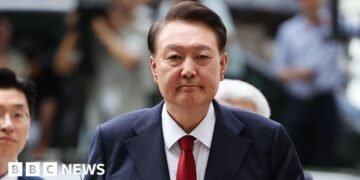























High-Stakes Trial: Former South Korean President Faces Death Penalty for Martial Law Attempt
In a dramatic turn of events, South Korean prosecutors have called for a death sentence for former President Yoon Suk Yeol, if convicted of attempting to impose martial law in late 2024. The trial, which has captivated the nation, explores Yoon’s alleged actions during a brief but tumultuous declaration of military rule that shook the fabric of South Korean democracy.
Why It Matters
This case not only centers on Yoon’s presidency but also represents a broader struggle in South Korea between democratic governance and authoritarian impulses. With a potential death sentence on the table, the verdict carries significant implications for the rule of law, political accountability, and the nation’s turbulent history with military governance.
Key Developments
- Prosecutors have charged Yoon as the "ringleader of an insurrection," seeking the death penalty or life imprisonment.
- The trial stems from Yoon’s decision to declare martial law on December 3, 2024, which lasted only hours but caused widespread political upheaval.
- Testimony during the trial included remarks from a military commander regarding Yoon’s alleged orders to arrest lawmakers.
- Evidence presented included a memo from a former military officer, suggesting the elimination of various political opponents and media figures.
- Yoon has remained in detention for months, facing multiple criminal charges, including a separate obstruction of justice case.
Full Report
Closing Arguments Overview
A court in Seoul recently concluded closing arguments in Yoon’s trial, where prosecutors emphasized his reckless intent during the martial law attempt. Although the declaration resulted in no casualties, the prosecution asserted that Yoon’s actions were inherently violent and aimed at consolidating power.
In their statements, they cited testimonies from military personnel, including a commander who claimed Yoon directed the arrest of opposition lawmakers. To bolster their case, the prosecution revealed a troubling memo by a former military officer that contained plans for the "disposal" of those opposing Yoon’s regime.
Yoon’s Defense
Yoon has robustly denied the allegations against him, framing his martial law attempt as a symbolic action intended to highlight the wrongdoing of rival political factions. He claims that the declaration was meant to safeguard the country from perceived threats, particularly from North Korea.
Political Ramifications
Yoon’s 2024 martial law announcement not only led to his impeachment but also resulted in his historic arrest—the first for a sitting South Korean president. Following these events, Lee Jae Myung was elected as president in a hurried election, further deepening the political divide in the nation. Despite his fall from grace, Yoon maintains a loyal supporter base among right-wing factions that regard him as a martyr in his battle against a liberal opposition.
Context & Previous Events
In 1996, the last death sentence in South Korea was handed to former military dictator Chun Doo-hwan, who was convicted for a coup undertaken in 1979. His sentence was later commuted to life imprisonment. Yoon’s current trial underscores a lingering anxiety regarding military interference in politics, a theme deeply rooted in South Korea’s history.
As the nation awaits a verdict expected in February, the implications of this trial extend beyond one man, touching on the very essence of democracy in South Korea.