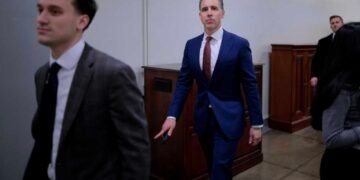























In a significant political maneuver, Senate Republicans have successfully blocked a war powers resolution that aimed to require President Trump to seek congressional approval before conducting military operations in Venezuela. This reversal of support comes just days after several GOP senators had initially diverged from party lines to back the legislation, marking a rare moment of dissent within the Republican ranks.
The implications of this vote are profound, highlighting ongoing tensions between the executive branch and Congress regarding the authority to engage in military actions. With President Trump eyeing potential military options not only in Venezuela but also in other regions, the Senate’s failure to assert control over such decisions underscores the complex dynamics governing U.S. military engagement.
Key Developments
- Sen. Josh Hawley (R-Mo.) reversed his prior support and voted against the war powers resolution after discussions with Secretary of State Marco Rubio.
- The final vote on the resolution was 51 to 50, facilitated by Vice President JD Vance’s tie-breaking vote.
- Two other Republicans, Todd Young (R-Ind.) and Hawley, joined the majority in rejecting the measure.
- Trump criticized the five GOP senators who initially voted with Democrats, calling for accountability.
- The blocked resolution was a direct response to the recent U.S. operation that resulted in capturing Venezuelan President Nicolás Maduro.
Full Report
Voting Dynamics and Shifts
Initially, five Republican senators supported advancing the war powers resolution, a move that was perceived as a rare bipartisan challenge to President Trump. However, by Wednesday, Senate Majority Leader John Thune (R-S.D.) orchestrated a shift, convincing two of the defectors to align against the resolution. As a result, the legislation was effectively blocked with a narrow margin.
Senator Statements
Speaking on the vote, Senator Hawley expressed that his apprehensions regarding U.S. intervention in Venezuela were mitigated after consultation with Secretary Rubio. Todd Young also indicated a change of heart, citing reassurances from national security officials regarding the absence of American troops in Venezuela. Young asserted that if military needs arose, the Administration would seek Congress’s authorization beforehand.
Trump’s Response
Following the initial dissent from Republican senators, Trump expressed his displeasure, suggesting that those who voted against party lines should face consequences. His statements reflect a keen interest in maintaining party unity on foreign policy matters, particularly military engagement.
Context & Previous Events
This vote marks the latest failure in Congress’s attempts to reclaim authority over military actions, building on previous setbacks experienced last year with similar resolutions. As discussions about military involvements in regions like Iran and Greenland continue, Senate Democrats have signalled plans to persist in pushing for more votes on war powers moving forward.






