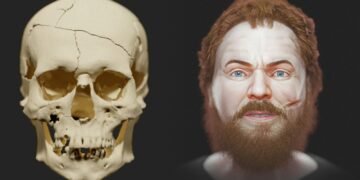























Face of 400-Year-Old ‘Vampire’ Revealed in Croatia
For the first time in over 400 years, the face of a man believed to have been classified as a “vampire” has been reconstructed, shedding light on the superstitions and burial practices of past centuries. This discovery comes from Racesa, a fortress in eastern Croatia, where experts unearthed remains that had been deliberately mutilated to prevent the deceased from rising from the grave.
Why It Matters
This finding not only offers a glimpse into the beliefs surrounding death and the supernatural in medieval Europe but also highlights how societal views on violence and deviance shaped burial rituals. The significance lies in understanding how fear of the undead played a role in early European cultures, particularly in their extreme measures to deter potential threats after death.
Key Developments
- The remains were uncovered beneath heavy stones, suggesting intentional burial practices aimed at preventing the individual from becoming a vampire.
- Archaeologist Natasa Sarkic revealed that the deceased had a history of violent conflict, contributing to the fear surrounding him in life and death.
- Graphics expert Cicero Moraes employed advanced techniques to reconstruct the man’s facial features based on his skull.
- The Racesa “vampire,” estimated to have lived in the 15th or 16th century, faced significant violence during his life, potentially as a soldier or someone engaged in violent altercations.
Full Report
Scientific Findings
After examining the remains, experts concluded that the body had been subjected to several disfiguring injuries during the individual’s lifetime, culminating in a fatal attack. Sarkic noted that the person’s violent history and resulting disfigurements likely contributed to the community’s perception of him as a threat, which led to the anti-vampire burial practices.
Reconstruction Technique
To recreate the face, Moraes worked with data obtained from a CT scan of the skull. Although the skull was fragmented, it was digitally reconstructed through sophisticated visualization techniques. Moraes emphasized that the final product reflects an objective representation of the man, devoid of speculative features like hair or skin color, but highlighting the signs of a life fraught with conflict.
Burial Practices
The burial site itself, located within a church but in a disregarded area, further signifies the social stigma surrounding the individual. Additional analysis revealed he had been beheaded and reburied face down, encapsulating rituals believed to thwart his return from death as a vampire. These practices were typical of the Slavic traditions that perceived the dead as capable of haunting the living.
Historical Context
Racesa, where the burial was found, has a complicated history, having been occupied by various groups including the Knights Templar and the Knights Hospitaller. This recent discovery adds to the array of European sites revealing similar vampire-related burials, echoing fears that reverberated throughout historical societies.
Context & Previous Events
Other notable instances include the 1725 case of Petar Blagojevic in Serbia, who was staked and burned as a suspected vampire after his death. Additionally, a Croatian man named Jure Grando Alilovic was recorded as a vampire in historical texts stemming from his life and death. These findings underscore a long-standing belief in the supernatural and the lengths to which communities would go to maintain their safety against perceived threats.