






















U.S. Officials Outline Plans for Stabilizing Venezuela Following Maduro’s Capture
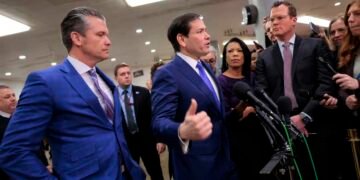
Secretary of Defense Pete Hegseth and Secretary of State Marco Rubio held a press conference on Capitol Hill Wednesday, detailing a strategy aimed at stabilizing Venezuela following the recent capture of President Nicolas Maduro and his wife, Cilia Flores. Their comments come after a closed-door briefing with senators, underscoring the urgent need to address the country’s ongoing turmoil.
The stakes are high as Venezuela has grappled with political instability, economic decline, and humanitarian crises for years. The U.S. government’s involvement in what it terms a "stabilization" process signifies a significant shift in its approach toward the South American nation, targeting both recovery and reconstruction for the Venezuelan populace.
Key Developments
- Quarantine Process: Rubio stated that the first phase involves a quarantine strategy to regulate the sale of sanctioned Venezuelan oil, with intent to control profits for the benefit of citizens rather than the existing regime.
- Seizure of Oil Tankers: Officials plan to seize between 30 and 50 million barrels of oil from the Venezuelan market to re-sell at market rates.
- Fair Access and Reconciliation: The second phase will focus on restoring access to the Venezuelan market while initiating a national reconciliation process, allowing for the amnesty and return of opposition members.
- Overlapping Phases: While specifics on the transition phase remain undisclosed, Rubio indicated that there would be overlapping activities among the different stages of the plan.
Full Report
Details of the Stabilization Plan
In their briefing, Rubio emphasized that a controlled quarantine would be vital in maintaining order during the transitional period. “We don’t want it descending into chaos,” he remarked, highlighting the importance of managing the oil sale process to directly benefit Venezuelans rather than the corrupt regime.
The strategic seizure of oil tankers forms a cornerstone of this initiative. Rubio announced plans to take possession of a significant quantity of Venezuelan oil, which will be marketed at standard prices rather than the deep discounts previously faced by the country. The generated revenue is expected to undergo rigorous management to ensure that it aids the Venezuelan public, not the corrupt officials of the Maduro regime.
Steps Towards Recovery and Transition
Moving into phase two, the focus will shift toward economic recovery and reconciliatory measures. “We will work to create an environment where opposition leaders can be released from prisons and restored to society,” Rubio explained, emphasizing a unified approach to rebuilding civil society in Venezuela.
Although details concerning the final transition phase were scant, Rubio indicated that plans would be further articulated as the process unfolds. He noted the potential for different phases to happen concurrently, indicating a flexible approach to the situation in Venezuela.
Context & Previous Events
The press conference follows the significant political upheaval in Venezuela, where Maduro’s regime has faced widespread international criticism and domestic unrest. The recent capture of Maduro and his wife presents a pivotal opportunity for the U.S. to influence Venezuela’s future direction. This renewed focus on a structured stabilization and recovery plan marks a new chapter in U.S. involvement in Venezuelan affairs.






