






















Putin’s Stalled Negotiations Highlight Deadlock in Ukraine War
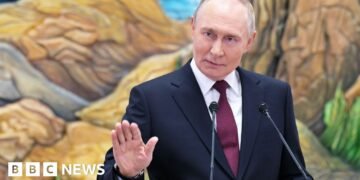
Russian President Vladimir Putin has reiterated his demands for an end to the conflict in Ukraine, insisting that Russia will cease hostilities only when Ukrainian forces withdraw from territories that Moscow claims. This latest statement comes as diplomatic efforts to address the war’s escalation appear to stall.
The stakes in this ongoing conflict remain high, as both sides stand firm on their positions. For Ukraine, conceding any territory to Russia is not negotiable, and such an outcome could lead to escalated violence and further destabilization in Europe. Efforts by the United States and its allies to mediate a peace deal are being closely monitored, but skepticism persists regarding Moscow’s commitment to a genuine resolution.
Key Developments
- Putin declared that Russia will only stop fighting if Ukrainian troops withdraw from the contested Donbas region and Crimea.
- Ukrainian President Volodymyr Zelensky accused Russia of disregarding efforts to find a real end to the war.
- Putin questioned Ukraine’s leadership legitimacy, stating that signing agreements with them would be pointless.
- A U.S. delegation is expected to visit Moscow to discuss the recent draft peace plan that favors Russian demands.
- Recent diplomatic maneuvers have led to intense discussions involving the U.S., Ukraine, and Russian officials but have not resolved key issues related to occupied territories.
Full Report
Putin’s Demands
During a recent address, Putin made it clear that Russia would only cease military actions if Ukrainian forces withdraw from territories claimed by Moscow. He emphasized that the territories in question include the southern Crimean peninsula annexed in 2014 and the Donbas region, where Moscow’s presence is predominant.
Ukrainian Response
Zelensky responded to Putin’s comments, suggesting that Russia has “scorned” meaningful efforts to achieve peace. The Ukrainian president firmly maintains that surrendering parts of the Donbas is an unacceptable outcome, thereby illustrating Kyiv’s unwavering stance against rewarding Russia’s aggression.
Military Assessments
Despite Putin’s assertive claims of control on the battlefield, recent assessments from the Institute for the Study of War indicate that Russia’s slow progress in eastern Ukraine comes at a significant cost in manpower. Current trends suggest it could take nearly two years for Russia to fully seize the remaining portions of the Donetsk region.
Diplomatic Movements
Putin’s remarks marked the first acknowledgment of the recent surge in diplomatic activity aimed at peace discussions. This includes a newly revised peace plan seen as favoring Russian interests, which he stated could serve as a foundation for future negotiations. However, he stressed that “certain specific points” must be addressed in formal diplomatic discussions.
Legitimacy and Elections
In a further indication of his dismissive view towards Ukraine’s leadership, Putin expressed that he does not recognize the legitimacy of Zelensky’s administration, citing its governance under martial law since Russia’s invasion in February 2022. Despite Ukraine’s parliament affirming Zelensky’s legitimacy, this perspective complicates any potential agreements.
Context & Previous Events
This dialogue occurs against the backdrop of an ongoing war that has persisted since Russia’s full-scale invasion in February 2022. The conflict has led to international consequences and has amplified discussions among European leaders regarding security and territorial integrity in the region.
Though America’s recent diplomatic efforts have generated a semblance of optimism, many European officials remain skeptical about Russia’s true intentions regarding a peaceful resolution, particularly given Putin’s historical assertions and aggressive moves toward territorial expansion.