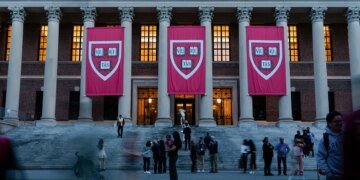























Title: Harvard Professor Departs, Critiques ‘Wokeness’ and Academic Standards
Lede
After four decades at Harvard University, history professor James Hankins has officially retired and left the Ivy League institution, taking the opportunity to voice a sharp critique of its evolving academic climate. In an article for Compact Magazine, he articulated concerns about the increased "wokeness" and COVID-19 restrictions at the university, which he believes have influenced both the administration and academic standards.
Why It Matters
Hankins’ departure and critical remarks shine a light on ongoing debates surrounding higher education in America, particularly regarding issues of academic freedom, admission policies, and the impact of social movements on curriculum. As conversations about inclusion and diversity continue to evolve, the ramifications of such changes on traditional educational values are becoming increasingly pronounced.
Key Developments
- James Hankins opted to leave Harvard after a 40-year career, fulfilling a retirement contract that lasted four years.
- He cited overly strict COVID-19 measures and what he views as a growing culture of "wokeness" as primary reasons for his departure.
- Hankins expressed concerns over graduate admissions, claiming that discrimination against White male applicants has become apparent in the admissions process.
- He criticized the decline of academic standards in the history department, linking it to pressures for increased diversity among faculty.
- Hankins is now a visiting professor at the University of Florida.
Full Report
COVID-19 Restrictions
Hankins noted that his decision to leave Harvard was precipitated by two years of stringent COVID-19 protocols that he felt were excessive. He described an environment where professors were forced to give lectures wearing masks and conduct seminars via Zoom, which he argued did not align with effective educational practices.
Concerns Over Admissions Policies
Reflecting on the impact of the 2020 protests following George Floyd’s death, Hankins claimed that the university’s response included what he labeled "empty virtue-signaling." He recounted a troubling experience during graduate admissions in which he was told that admitting a strong white male candidate was “not happening this year.” He argued that this trend reflected a broader policy shift in admissions practices across many institutions.
Decline in Academic Standards
Throughout his tenure, Hankins observed a deterioration in academic rigor within the history department. He explained that prior to the 1990s, there was a "two-book standard" for faculty appointments that ensured a level of scholarly excellence. However, this standard was eventually abandoned due to demands for increased female faculty representation, leading to what he sees as lowered expectations and the promotion of less qualified candidates.
Hankins attempted to counteract this trend by implementing a curriculum requirement focused on Western civilization. Unfortunately, he noted that this initiative was short-lived and failed to halt the reorientation toward "global civilizations" that he believes does not fairly represent Western history.
Context & Previous Events
The erosion of traditional academic standards at elite universities has been a topic of contention amid growing demands for diversity and inclusion in higher education. Hankins’ reflections echo waves of criticism voiced by other academics regarding the perceived imbalance between social justice goals and the preservation of rigorous academic integrity. The push for more inclusive faculty has been a significant force shaping hiring practices and curriculum at many institutions of higher learning.






