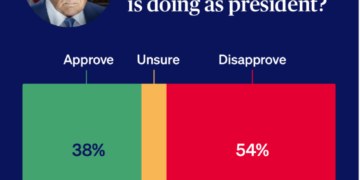























Trump Faces Record Low Approval Ratings Amid Economic Concerns
President Donald Trump has registered his lowest approval ratings to date regarding his handling of the economy, according to a new PBS News/NPR/Marist poll. With widespread worries about rising costs of living, healthcare, and personal financial stability, 57% of Americans have expressed disapproval of the president’s economic management.
Why It Matters
The economic landscape is pivotal for political candidates, especially as the 2024 presidential elections approach. As concerns about affordability dominate public discourse, the Republican Party may face challenges in maintaining voter support, particularly among independents and those affected by economic strain. This shift in perception could critically impact the upcoming midterm elections.
Key Developments
- Approval Ratings: 57% of Americans disapprove of Trump’s economic management, while only 36% believe he is performing well.
- Overall Approval: Only 38% of Americans approve of Trump as president, representing a significant decline since the end of his first term.
- Cost of Living Woes: Approximately 70% of Americans view the cost of living in their area as unaffordable, including nearly half of Republicans.
- Voter Sentiment: Registered voters express a preference for the Democratic Party over Republicans regarding economic issues (40% to 35%).
- Economic Outlook: More than half of Americans anticipate a worsening economy in 2026, with 57% expressing pessimism about future economic conditions.
Full Report
Economic Discontent
The PBS News/NPR/Marist poll reveals a stark public sentiment regarding the economy, which has traditionally been perceived as one of Trump’s strengths. The dissatisfaction stems largely from rising costs that strain countless households across the nation. Public opinion expert Lee Miringoff noted that “when affordability is so front and center in people’s minds, that’s going to be laid at the doorstep of a chief executive.”
While focusing on the economy, the poll illustrates a significant decline in voter confidence since September 2022, when Republicans held a notable advantage on economic issues. Now, independents are showing a strong preference for Democratic strategies. This trend has implications for the Republican Party, especially since they currently control the executive and legislative branches.
Growing Concerns Among Voters
A substantial part of the population, including many who previously supported Trump, expresses dissatisfaction with the current economic conditions. Independent voter Roger Chester, who voted for Trump, articulated a shift in his perception of the president, likening him to a "populist puppet" who adapts according to his supporters’ needs. Despite his frustrations, Chester acknowledged Trump’s efforts in keeping promises but lamented the unbearable prices of essential goods.
Similarly, Sherry Kamphaus, another voter who identifies as Republican, has begun to question Trump’s role in addressing rising food prices, expressing that the party has failed to fulfill its commitments on economic relief.
Healthcare costs remain another key issue. With expected premium increases and the expiration of subsidies for the Affordable Care Act, public concern about healthcare affordability looms large. More than half of those surveyed expressed worries about their ability to cover essential medical expenses in 2026.
Despite some signs of hope, such as a decrease in public worry regarding tariffs and a perception that the economy may not be in a recession, Trump faces an uphill battle in regaining confidence among voters.
Context & Previous Events
Public discontent over economic issues has mirrored challenges faced by previous administrations. Joe Biden experienced similar struggles during his presidency as inflation rates surged. Historically, economic dissatisfaction has influenced election outcomes, highlighting how critical economic policies and perceptions are to voter behavior. As the midterms approach, both parties are likely to focus on affordability and economic recovery to sway the electorate.






