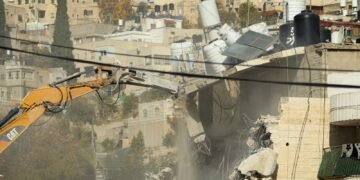























Demolition in Silwan Evicts Residents, Sparks Outrage
Residents of Silwan’s Wadi Qaddom neighborhood watched helplessly as their homes were reduced to rubble in a lengthy demolition conducted by Israeli authorities. This incident has left approximately 100 individuals homeless, escalating tensions in a region already fraught with conflict.
Why It Matters
The demolition highlights ongoing issues surrounding housing rights and urban planning in East Jerusalem, where residents face significant challenges in securing building permits. The situation has broader implications for the Israeli-Palestinian conflict, particularly as housing demolitions continue to affect Palestinian communities, drawing international scrutiny over Israel’s policies in the area.
Key Developments
- The four-storey building demolished was home to around 100 residents, many of whom are now displaced.
- Israeli police cordoned off the region during the 12-hour demolition process, which began at dawn.
- The building lacked a permit and was situated on land deemed unauthorized for residential use.
- Jerusalem Municipality claims the demolition followed a 2014 court order, stating extensions were provided but refused by the residents.
- Israeli official Itamar Ben-Gvir defended the demolition as part of a broader policy to address illegal construction.
- Recent announcements included the approval of 19 new Jewish settlements in the occupied West Bank amid a rise in housing tensions.
Full Report
Onlookers and Emotional Responses
A gathering of onlookers filled balconies and sidewalks, keenly observing the destruction of the building that had been a constant in their neighborhood. An elderly woman, visibly agitated, expressed her dismay at the lack of support from Arab nations. "Where are the Arab countries? No one is here to help us," she exclaimed, emphasizing her desperation amidst the destruction.
Legal and Urban Planning Challenges
The building’s demolition was instigated by existing legal orders. Residents had been contesting long-standing demolition notices while pursuing permits. Sari Kornish, an architect from the Israeli NGO Bimkom, stated that their ability to respond to these orders was severely limited by time constraints. “Six months is not enough for these planning processes. They take a long time,” she noted, further highlighting systemic challenges faced by Palestinian communities.
Government Reaction
Israel’s far-right Finance Minister, Bezalel Smotrich, recently announced that the security cabinet had approved the establishment of additional Jewish settlements in the West Bank, adding to existing tensions. Meanwhile, nearly 500 Palestinians have faced the loss of homes due to similar demolitions, with many others at risk of eviction from ongoing legal cases.
Life Amid Demolition Sites
In another area of Silwan, Zuhair al Rajabbi described how the landscape had transformed, with former homes replaced by demolition sites and Israeli settler flags. He shared poignant memories of the families that once inhabited these homes, expressing sorrow over their displacement. “We used to live together… It makes me sad when I see their home disappearing,” he said, reflecting on the fractured community ties.
Context & Previous Events
In 2025 alone, over 230 buildings were demolished in East Jerusalem’s Palestinian neighborhoods. Amidst ongoing legal battles over permits and land rights, the region continues to see a substantial number of forced displacements tied to Israeli housing policies, often exacerbated by the actions of settler organizations in Israeli courts.