






















Safety Concerns Raised Over Defense Bill Following Deadly Aviation Collision
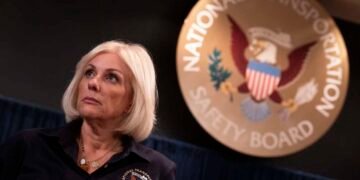
In a stark warning, the chairwoman of the National Transportation Safety Board (NTSB), Jennifer Homendy, criticized a provision in the National Defense Authorization Act (NDAA) that could reverse crucial aviation safety measures. This comes in the wake of a tragic January mid-air collision that resulted in 67 fatalities, raising alarms about the future of aviation safety in the U.S.
Why It Matters
The proposed legislation has the potential to roll back advancements made to enhance the safety of military and commercial aviation. Amid growing concerns about military aircraft accidents, the implications of these legislative changes could endanger the public and provoke further tragedies similar to the January incident.
Key Developments
- Jennifer Homendy labeled the NDAA provision “a safety whitewash” and expressed outrage over its implications.
- The NTSB previously recommended military aircraft use Automatic Dependent Surveillance–Broadcast (ADS-B) technology to prevent mid-air collisions.
- The current NDAA language creates exemptions to the use of ADS-B, potentially reinstating dangerous conditions that led to the deadly crash.
- Federal lawmakers, including Senators Ted Cruz and Maria Cantwell, echo concerns that the NDAA maintains outdated aviation regulations.
- Family members of the victims of the January collision are calling for stronger safety measures to protect future flights.
Full Report
During a press conference, Homendy expressed strong opposition to a section of the NDAA that could hinder safety improvements in aviation. “If it sounds like I’m mad, I am mad. This is shameful,” she stated, underscoring the board’s commitment to preventing further disasters.
The National Defense Authorization Act, currently under discussion in Congress, includes provisions that would allow certain military helicopters to avoid compliance with mandated safety technologies. After the January incident involving a Black Hawk helicopter and an American Airlines regional jet, the NTSB recommended mandatory ADS-B technology for military flights, a measure the Pentagon had initially agreed upon. However, the NDAA’s proposed modifications might create loopholes that could exacerbate aviation risks, according to Homendy.
In response to concerns, key congressional leaders defended the NDAA, claiming it requires helicopters in Washington, D.C. airspace to alert other aircraft of their presence. Nonetheless, the specifics of the bill do not ensure the mandatory use of ADS-B technology, as emphasized by several lawmakers who shared the NTSB’s reservations. Senators Cruz, Cantwell, Moran, and Duckworth criticized the bill for permitting military aircraft to operate under regulations that differ from those for commercial flights, especially amid data revealing an increase in military aviation accidents since 2020.
Family members of the victims, such as Tim and Sheri Lilley, whose son lost his life in the collision, expressed their concerns in a public statement. They urged Congress to reinforce the safety measures to prevent future tragedies, asserting that current legislative proposals inadequately protect the public.
Context & Previous Events
This mounting criticism is rooted in a January mid-air collision near Ronald Reagan Washington National Airport, which resulted in the deaths of 67 individuals. This incident marked the deadliest aviation disaster in over two decades and prompted a reevaluation of safety protocols for military aircraft operating in civilian airspace.






