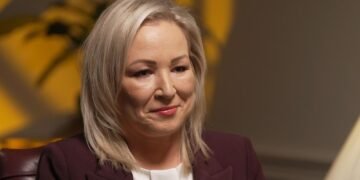























Northern Ireland’s First Minister Advocates for 2030 Referendum on Irish Unity
Northern Ireland’s First Minister Michelle O’Neill has called for a referendum by 2030 regarding the region’s potential unification with Ireland. Stating it’s time for the people to take charge of their destiny, O’Neill emphasizes the importance of proactive planning for this pivotal decision.
Why It Matters
The call for a border poll reflects ongoing tensions surrounding Northern Ireland’s status following Brexit, with significant implications for both political and economic landscapes. A referendum could reshape the future of the region, igniting debates about identity, governance, and community relations.
Key Developments
- Michelle O’Neill stated a preference for a referendum on Irish unification by 2030.
- O’Neill criticized the negative consequences of Brexit, labeling it "economic self-harm."
- Ireland’s Premier Micheal Martin has previously indicated that a border poll will not occur before 2030.
- Northern Ireland’s Deputy First Minister Emma Little Pengelly responded by highlighting that nationalist and republican vote shares have remained stagnant since 1998.
Full Report
O’Neill’s Vision for the Future
During an interview on Sunday Morning With Trevor Phillips, O’Neill articulated her support for a referendum, marking it as a crucial opportunity for the people of Northern Ireland to assert control over their future. When posed with the question of a potential border poll while serving as First Minister, she stated unequivocally that she envisions this happening. Emphasizing the urgency of preparation, she added that 2030 is just around the corner.
Critiquing the impacts of Brexit, O’Neill expressed her concern that the decisions made during that process did not align with the will of the people. She believes that taking charge of their own future is vital for the residents of Northern Ireland.
Pengelly’s Counterpoint
In contrast, Deputy First Minister Emma Little Pengelly, also appearing on the same program, underscored the idea that the nationalist and republican factions have not gained ground in terms of voter support since the Northern Ireland Assembly was established in 1998. Little Pengelly, identifying as a unionist, remarked that these groups are operating on a similar percentage of votes as they did over two decades ago. She posited that calls for a border poll are often propelled by those seeking to create an illusion of momentum, which she asserts does not exist in the region.
The differing perspectives between O’Neill and Little Pengelly encapsulate the complex political dynamics that continue to shape Northern Ireland’s future.
Context & Previous Events
Ireland’s Premier Micheal Martin had previously stated there would not be a border poll before 2030, which appears to stand in contrast to O’Neill’s call for moderation. Since the establishment of the Northern Ireland Assembly in 1998, discussions surrounding nationalism, unionism, and identity have remained central to the region’s political debates. Despite these longstanding tensions, electoral results show little change in the voting landscape among nationalist and republican parties.