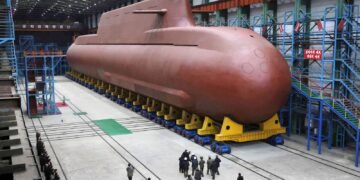























North Korea Advances in Nuclear-Powered Submarine Development
North Korea has made notable progress in its nuclear submarine capabilities, showcasing what appears to be a near-completed hull of an 8,700-ton-class nuclear-powered submarine. The unveiling comes as leader Kim Jong Un emphasizes the submarine’s potential to enhance the country’s nuclear deterrent against perceived threats, especially from South Korea and its U.S. allies.
Why It Matters
The development of a nuclear-powered submarine marks a significant leap for North Korea’s military capabilities. Such vessels are capable of prolonged underwater missions and launching missiles stealthily, complicating monitoring efforts by neighboring nations. With the geopolitical landscape increasingly tense, this advancement raises alarm about regional security and the potential for escalated military responses.
Key Developments
- State media images revealed Kim Jong Un inspecting a largely completed nuclear submarine hull during a recent shipyard visit.
- Kim referred to the completion of the submarine as an "epoch-making" change for North Korea’s military resilience.
- He expressed strong opposition to South Korea’s plans for acquiring a nuclear submarine, viewing it as a direct threat to North Korean security.
- Experts suggest that the submarine could be ready for sea trials within months, given the apparent installation of essential components.
- North Korea continues to enhance its military arsenal, including solid-fuel intercontinental ballistic missiles (ICBMs) and advanced weapons systems identified during a 2021 military meeting.
Full Report
Recent Developments in Submarine Construction
Images released by North Korea’s official Korean Central News Agency (KCNA) show Kim Jong Un’s recent visit to a shipyard, the first since March, where he examined what appears to be a nearly complete nuclear submarine. Experts believe that the visible hull indicates that most essential systems, including the engine and possibly the reactor, have already been integrated.
Moon Keun-sik, a submarine specialist at Seoul’s Hanyang University, stated that the showcased vessel likely indicates readiness for launch, supporting claims that it could be tested at sea in a few months.
Kim Jong Un’s Position
During his visit, Kim denounced South Korea’s acquisition efforts for a U.S.-backed nuclear submarine as an "offensive act," which he believes violates North Korea’s security and sovereignty in maritime domains. He argues that these developments necessitate the enhancement of North Korea’s naval nuclear capabilities.
Concerns Over North Korea’s Technological Capacity
While there are significant advancements, questions linger regarding North Korea’s ability to sustain this submarine program amidst ongoing international sanctions. Analysts suggest that bolstered ties with Russia could be facilitating access to key technologies essential for submarine development.
Regional and Global Implications
The construction of a nuclear-powered submarine could escalate military tensions in the region, especially as North Korea’s government has rebuffed calls from Washington and Seoul for renewed diplomatic negotiations regarding its nuclear and missile capabilities. Past talks have stalled following a breakdown in negotiations during a failed summit in 2019.
Context & Previous Events
In 2021, Kim outlined advanced weapons, including nuclear-powered submarines, as countermeasures against perceived U.S.-led threats. The development of these submarine capabilities follows several tests of solid-fuel ICBMs, hypersonic weapons, and the unveiling of a new destroyer aimed at improving North Korea’s nuclear strike capabilities. The geopolitical climate remains fraught, particularly following South Korean President Lee Jae Myung’s plea for U.S. support to enhance defense systems, representing a shift in regional military dynamics.