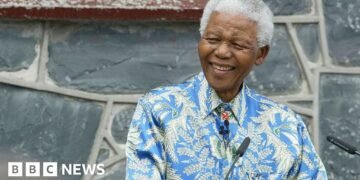























A South African court has upheld a decision allowing the sale and export of personal items belonging to anti-apartheid icon Nelson Mandela, dismissing an appeal from the country’s heritage agency. The ruling allows a collection of 70 significant artefacts to be auctioned in the U.S., including a key from the cell where Mandela was imprisoned for nearly two decades.
The decision highlights an ongoing debate over the ownership and preservation of cultural heritage. As Mandela’s legacy continues to resonate worldwide, the question of whether personal possessions linked to his life should remain in South Africa or be sold abroad raises important issues about national identity and cultural stewardship.
- The South African Supreme Court of Appeal dismissed the South African Heritage Resources Agency’s (Sahra) appeal to halt the auction of artefacts linked to Nelson Mandela.
- The collection includes items such as Mandela’s Robben Island cell key, a pair of Aviator sunglasses, and signed personal documents.
- Mandela’s daughter, Makaziwe Mandela, plans to use proceeds from the sale to fund a memorial garden at her father’s grave.
- The court ruled that Sahra’s interpretation of heritage laws was too broad and lacked justification.
- Debate remains ongoing over whether heritage items should stay in South Africa or be sold by the family.
South Africa’s Supreme Court of Appeal has ruled in favor of allowing the sale of several artefacts directly associated with Nelson Mandela, who is celebrated for leading the fight against apartheid. The 70 personal items are owned by Mandela’s eldest daughter, Makaziwe, and Christo Brand, a former Robben Island warden during Mandela’s imprisonment. The collection includes notable items such as Mandela’s prison ID card, a signed copy of the 1996 South African Constitution, and gifts received from global leaders, including former U.S. President Barack Obama.
Sahra initially sought to prevent the auction, asserting that the items form part of South Africa’s cultural heritage and should not be exported. In response to the potential sale, Sahra became aware of the auction plans through a 2021 article in a British newspaper, which estimated the key from Mandela’s cell would sell for over $1 million. The agency contacted the auction house, Guernsey, seeking to suspend the sale and return the artefacts to South Africa.
In its judgment, the court criticized Sahra for failing to adequately justify its claims regarding the heritage status of the items. Meanwhile, Makaziwe Mandela welcomed the court’s decision, expressing disappointment in Sahra’s assumptions about her father’s wishes. She emphasized that the family is most invested in preserving Mandela’s legacy as he would have wanted.
Despite the ruling, debates surrounding the sale continue, with some arguing that items related to Mandela should remain in South Africa for future generations to appreciate, whereas others defend the family’s right to make decisions about their father’s possessions.
The South African Heritage Resources Agency first became aware of the auction in late 2021, prompting them to take legal action. Mandela, who passed away in 2013 at the age of 95, was instrumental in dismantling apartheid and served as South Africa’s first democratically elected president in 1994. His contributions to peace and reconciliation were recognized globally, earning him the Nobel Peace Prize in 1993 alongside then-President FW de Klerk.