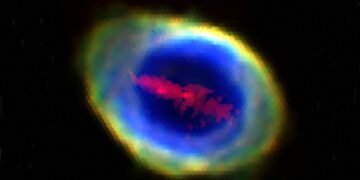























Mysterious Cloud Discovered in the Ring Nebula
Astronomers have identified a peculiar, bar-shaped cloud of iron atoms within the Ring Nebula, also known as Messier 57. Located about 2,600 light-years from Earth in the constellation Lyra, this nebula represents the remnants of a sun-like star and provides insights into the fate of similar stars, including our own sun.
Why It Matters
This discovery raises intriguing questions about stellar evolution and planetary formation. The structure of the iron cloud could hold clues about the processes that occur when stars exhaust their nuclear fuel and evolve into white dwarfs. Understanding such phenomena can offer a glimpse into the potential future of our Solar System billions of years from now.
Key Developments
- A bar-shaped cloud of iron atoms was recently detected in the Ring Nebula.
- This cloud may be remnants from a vaporized rocky planet, potentially mirroring a fate that Earth could face in the distant future.
- The observation was made using the new WEAVE instrument on the William Herschel Telescope in the Canary Islands.
- The iron cloud stretches approximately 3.7 trillion miles (6 trillion kilometers) long.
- Researchers expressed surprise at the unique structure, indicating no other detectable elements co-exist in the same formation.
Full Report
Significant Discovery
The recent observation of the Ring Nebula highlights the continuing potential for new discoveries in well-studied astronomical phenomena. Using the WHT Enhanced Area Velocity Explorer (WEAVE), astronomers have uncovered a cloud of iron atoms that has sparked curiosity and debate within the scientific community.
“It is exciting to see that even a very familiar object can throw up a new surprise when observed in a new way,” stated astronomer Roger Wesson, affiliated with Cardiff University and University College London. His sentiments reflect the unexpected nature of the findings.
Research Insights
The research, published in the Monthly Notices of the Royal Astronomical Society, suggests that the iron atoms may be remnants of a rocky planet that was vaporized as the star expelled its outer layers during its transformation into a white dwarf. Study co-author Janet Drew pointed out that the unique structure of the iron cloud does not have a clear explanation, saying, “This is weird, frankly.” She noted that while the vaporization of a planet could account for the iron, alternative theories may also exist.
Wesson remarked on the enigma of the structure, acknowledging that while a planet like Earth would contain enough iron to form the bar, the process leading to its formation remains unclear.
Origins of the Ring Nebula
The Ring Nebula formed approximately 4,000 years ago, which is relatively recent in cosmic terms, after a star about twice the mass of our sun exhausted its nuclear fuel. This led to the star swelling into a red giant and eventually shedding its outer layers, resulting in the compact white dwarf that remains today.
Context & Previous Events
The Ring Nebula has been a subject of extensive astronomical study since its identification by French astronomer Charles Messier in 1779. Currently, astronomers know of around 3,000 such nebulae within our galaxy, making them vital for understanding the life stages of stars and their subsequent evolution.