






















Myanmar Denies Genocide Claims Against Rohingya at International Court
Myanmar has firmly rejected allegations of genocide against the Rohingya people as its representative presented the nation’s defense at the International Court of Justice (ICJ). The military-controlled government argues that the accusations are unfounded and lacks sufficient evidence, while The Gambia, leading the proceedings, has described the treatment of the Rohingya as part of a scheme to erase the minority group.
Why It Matters
The outcome of this case could have far-reaching implications for international law regarding genocide and the responsibilities of nations under international conventions. It represents a significant test of the ICJ’s ability to address complex humanitarian crises, and a ruling against Myanmar could set a precedent for similar cases globally, including those involving other countries and populations facing persecution.
Key Developments
- Myanmar’s representative, Ko Ko Hlaing, labeled genocide claims as "unsubstantiated" during the ICJ hearings.
- The Gambia’s foreign minister presented evidence of "genocidal policies" aimed at the Rohingya, labeling the situation as one of systematic oppression.
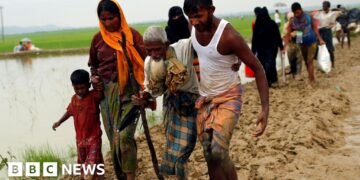
- Thousands of Rohingya were reportedly killed, and over 700,000 fled to Bangladesh during a military crackdown in 2017.
- A United Nations report from 2018 called for investigations into Myanmar’s military leaders for genocide and crimes against humanity.
- The Gambia initiated the case in 2019, motivated by its negative experience with military governance.
- The ICJ has allocated three days for witness testimonies, including accounts from Rohingya survivors, with sessions closed to the public and media.
- A final ruling is anticipated towards the end of 2026.
Full Report
Accusations of Genocide
During the proceedings at the ICJ, Hlaing stood firm against the allegations put forth by The Gambia, arguing that the country was justified in its military operations to maintain safety and combat terrorist activities in Rakhine State, where many Rohingya reside. He claimed that the military was acting against credible threats rather than targeting civilians.
The Gambia’s Argument
The Gambia’s legal team emphasized the severity of the situation faced by the Rohingya, arguing that the killing of women, children, and the elderly, alongside village destruction, cannot be justified as counter-terrorism efforts. They contend that evidence reveals a clear genocidal intent behind Myanmar’s policies toward the Rohingya population.
Myanmar’s Stance
In defense, Hlaing expressed Myanmar’s commitment to repatriating refugees and suggested that external factors, such as the COVID-19 pandemic, hindered those efforts. He argued that accusations of genocide severely damage Myanmar’s reputation and hold significant consequences for its future.
International Stake
The case, also backed by the Organisation of Islamic Cooperation, underlines the global significance of the Rohingya crisis. The potential for a ruling to refine international genocide definitions is observed closely, particularly in relation to other ongoing global issues.
Context & Previous Events
In 2017, a military crackdown in Myanmar led to the deaths of thousands of Rohingya and the mass displacement of over 700,000 individuals fleeing to Bangladesh. A UN report in 2018 implicated high-ranking military officials in ongoing crimes against humanity in Rakhine State, sparking international outcry and calls for accountability. The Gambia, driven by its historical experience with military rule, launched its legal action in 2019. The ICJ hearings represent one of the first major cases on genocide in over a decade.