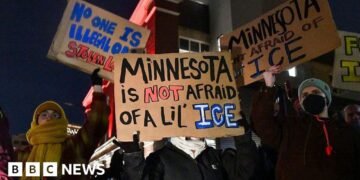























Protests Erupt in Minneapolis Over Fatal ICE Shooting
Minneapolis is in turmoil following the shooting death of Renee Nicole Good, a 37-year-old woman, by a U.S. Immigration and Customs Enforcement (ICE) agent. Protests erupted throughout the city, with over 1,000 demonstrators taking to the streets on Friday night, resulting in 29 arrests and one police officer injured.
Why It Matters
The incident involving Good has ignited widespread unrest and raised urgent questions regarding immigration enforcement tactics, particularly by ICE. This case highlights the heightened tensions surrounding immigration policy and has prompted protests not only in Minneapolis but across several states. As the FBI begins its investigation, the outcome could resonate beyond local repercussions and influence national discourse on immigration.
Key Developments
- At least 29 protesters were arrested during demonstrations in Minneapolis.
- The Minneapolis Police declared an unlawful assembly as crowds gathered outside a hotel believed to house ICE agents.
- A police officer sustained minor injuries when ice was thrown at them during the protest.
- Minneapolis Mayor Jacob Frey condemned vandalism while praising the overall peacefulness of the majority of demonstrators.
- Videos surfaced showing the shooting incident, further intensifying public outrage.
- The FBI has launched an investigation into the shooting, with local officials expressing frustration over being excluded from earlier inquiries.
Full Report
Protests Turn Violent
On Friday evening, Minneapolis saw a significant turnout for protests against immigration enforcement, sparked by the death of Renee Nicole Good. The protests escalated as demonstrators gathered outside the Canopy Hotel, where some ICE agents were believed to be staying. Some attendees reportedly forced entry into the hotel, prompting a police response. Videos circulated online depicted protesters using bright lights, whistles, and drums while others clashed with police, hurling ice, snow, and rocks. Despite the chaos, official accounts reported no significant injuries.
Chief of Minneapolis Police, Brian O’Hara, confirmed that the 29 individuals arrested were later released, and reiterated the department’s commitment to a restrained approach during crowd control. He noted the department had been receiving numerous complaints related to ICE operations.
Congressional Actions
In a separate event on Saturday, three Minnesota congresswomen attempted to inspect an ICE facility in the city but were barred from doing so. Democratic Representatives Ilhan Omar, Kelly Morrison, and Angie Craig asserted that their access was unlawfully obstructed, highlighting concerns over federal transparency. “They do not care that they are violating federal law,” Craig stated, while Omar emphasized that public knowledge of ICE operations is crucial.
Details of the Shooting Incident
Renee Nicole Good was shot and killed in her vehicle on Wednesday while allegedly attempting to drive away from ICE agents. Footage released shows agents confronting her, and as she attempts to flee, one agent draws a firearm and opens fire. Local authorities have challenged the narrative provided by officials that suggested Good was attempting to harm the officers. Mayor Frey labeled the self-defense claim as a "false narrative," insisting that Good posed no threat.
State and Federal Investigations
In light of the shooting, Minnesota officials announced they would initiate a separate inquiry after feeling sidelined by federal authorities. The Minnesota Bureau of Criminal Apprehension indicated that the FBI had initially agreed to conduct a joint investigation but later retracted this position. The case has now become a focal point for discussions on immigration enforcement, police conduct, and governmental accountability.
Context & Previous Events
The shooting has reignited frustration among Minnesotans regarding the presence and operations of ICE in the state. Recent protests against immigration enforcement have spread across various cities in the U.S., showcasing the growing dissent over federal immigration policies, especially those enacted during the previous administration. Good’s case adds to a series of contentious incidents involving immigration enforcement that have sparked broader national debates on human rights and the treatment of individuals by federal agents.