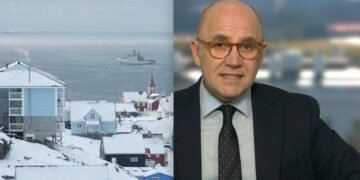























UK Government Firm on Greenland Amid US Tariff Threats
The UK government has reiterated its non-negotiable stance on the future of Greenland, asserting that the island’s destiny lies solely in the hands of its people. This declaration comes in the wake of President Donald Trump’s announcement of impending tariffs targeting the UK and other European nations, creating heightened tensions between the allies.
Why It Matters
The recent escalation over tariffs and Greenland’s status underscores the delicate balance of international relations, particularly within the transatlantic alliance. With the potential for significant economic repercussions, the UK government is facing pressure both domestically and abroad to maintain its position while mitigating any fallout from US trade actions.
Key Developments
- Sir Keir Starmer, leader of the UK opposition, condemned the proposed tariffs as "completely wrong."
- Culture Secretary Lisa Nandy stated that the UK’s position on Greenland is non-negotiable, emphasizing that the island’s future should be determined by its inhabitants.
- The US is set to impose a 10% tariff on goods from the UK and other European nations starting February 1, escalating to 25% by June if no agreement is reached regarding Greenland.
- Reform UK’s head of policy, Zia Yusuf, expressed concerns over how these tariffs could impact British manufacturers and workers.
- Annalena Baerbock, President of the UN General Assembly, affirmed that self-determination belongs to the people of Greenland and Denmark.
Full Report
UK Government’s Position
In response to the escalating economic threats from the US, UK officials have emphasized that they have consistently communicated their position to their American counterparts. Nandy highlighted that the decision regarding Greenland’s future is solely for its people and associated governance, stating, "We’ve been consistent about that."
Trump’s Tariff Announcement
On Saturday, Trump detailed his plans to impose tariffs on "any and all goods" from the UK, Denmark, Norway, Sweden, France, Germany, the Netherlands, and Finland. These tariffs aim to press for negotiations on the potential purchase of Greenland. The Culture Secretary condemned the tariffs as “completely wrong” and indicated that the UK must maintain good international relationships to navigate the situation effectively.
Reactions and Concerns
Leaders from various spheres are voicing their worries regarding the proposed tariffs. Zia Yusuf underscored the negative impact it could have on British industries, while reiterating that Nigel Farage’s engagement with Trump should only be at the request of the prime minister or the foreign secretary. Meanwhile, Annalena Baerbock stressed that international law is clear on issues of sovereignty and self-determination.
Context & Previous Events
The current geopolitical tensions over Greenland are rooted in its semi-autonomous status under Danish governance, where foreign and defense policies are managed by Denmark. Notably, Greenland’s future discussions have reignited following Trump’s previous interest in the territory, which he sought to purchase in 2019, causing notable diplomatic friction. The UN and EU are responding to the escalating situation, with EU ambassadors scheduled for an emergency meeting.






