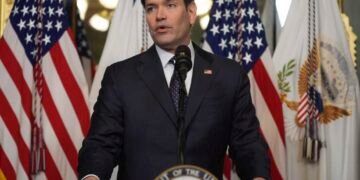























Rubio to Testify on Venezuela’s Future Amid Controversy Over His Dual Role
Secretary of State Marco Rubio is scheduled to testify before Congress on Wednesday, marking his first public address since former President Nicolás Maduro’s recent apprehension. This testimony comes amid rising scrutiny over Rubio’s dual position as both Secretary of State and National Security Adviser, a rare pairing last seen with Henry Kissinger in the 1970s.
Why It Matters
The stakes are high as the U.S. navigates its foreign policy towards Venezuela—a nation fraught with political instability and humanitarian crises. Rubio’s testimony will not only address immediate geopolitical implications but also raise questions about the administration’s decision-making structures and the influence wielded by an official holding two integral positions simultaneously.
Key Developments
- Rubio’s upcoming appearance on Capitol Hill coincides with increased focus on Venezuela following Maduro’s capture.
- The White House defends the streamlined National Security Council (NSC), claiming it supports more effective governance.
- Former National Security Adviser John Bolton expresses skepticism about any individual successfully managing both roles.
- The administration highlights a three-phase plan for Venezuela’s future, emphasizing stability before pursuing elections.
Full Report
The Dual Role Debate
Marco Rubio’s appointment to both Secretary of State and National Security Adviser has sparked considerable debate over the efficiency and efficacy of U.S. policy-making. Critics, including former National Security Adviser John Bolton, have expressed doubts regarding one individual’s capacity to balance such demanding responsibilities. Bolton emphasized the importance of a collaborative approach in formulating foreign policy, pointing out that a "top-down" strategy may overlook essential complexities.
The Administration’s Justification
A White House official, speaking on background, insisted that the current structure allows Rubio to execute President Trump’s directives more effectively. They posited that this streamlined approach enables quick responses to global challenges, despite critics labeling it as "inside baseball" complaints.
Rubio intends to present a three-phase plan to the Senate Foreign Relations Committee. This strategy includes immediate stabilization, facilitating recovery while ensuring American economic engagement, and ultimately transitioning towards a more democratic framework.
Geopolitical Considerations
Emily Horne, a former spokesperson for the NSC in the Biden administration, raised critical questions regarding the geopolitical strategy surrounding Venezuela’s operations. She noted the need for a comprehensive analysis of the implications for U.S. adversaries and allies and emphasized the importance of genuine foresight in policy implementation. A senior administration official dismissed these concerns, pointing to ongoing stability and a cooperative economic relationship as markers of success.
Context & Previous Events
This dual appointment represents a significant shift in how U.S. foreign policy is managed within the administration. This change was initiated after Trump’s request for Rubio to take over the National Security Council, following criticism of the previous administration’s approach. The focus on Venezuela emerged sharply after the detention of Maduro, prompting renewed discussions on the country’s future and U.S. intervention strategies.
Rubio has previously criticized established institutions like the NSC and the State Department, claiming they have become outdated and disconnected from the realities of modern geopolitics. His recent remarks portray an administration poised for decisive action, contrasting previous administrations’ deliberative tendencies.
The upcoming testimony promises to shed light on both the administration’s objectives in Venezuela and the broader implications of consolidating power within two of the nation’s foremost foreign policy roles.






