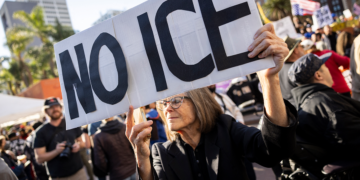























Los Angeles officials are exploring the establishment of “ICE-free zones” that would limit the use of county-owned property by federal immigration enforcement agents. This proposal, initiated by L.A. County Supervisor Lindsey Horvath, has emerged in response to a surge of anti-ICE protests nationwide following a recent controversial shooting during an immigration enforcement operation.
The proposed ordinance, which is set to be reviewed by the Los Angeles County Board of Supervisors, has significant implications for local governance and federal immigration practices. It highlights ongoing tensions between federal authorities and local governments regarding enforcement of immigration laws, as well as the substantial funding that local jurisdictions receive from the federal government.
Key Developments
- Los Angeles County is considering an ordinance to create “ICE-free zones,” requiring federal agents to seek permits for using county property for immigration enforcement.
- Protest actions against federal immigration policies have intensified nationwide, partly triggered by the fatal shooting of Renee Nicole Good.
- The proposal mandates that barriers and signage be erected on county properties to warn against unauthorized law enforcement activities.
- The potential for federal lawsuits is heightened, particularly with over $1 billion in annual federal funding for the county at risk.
Full Report
The Los Angeles County Board of Supervisors is expected to consider an ordinance that aims to limit the operational reach of U.S. Immigration and Customs Enforcement (ICE) within the county. The initial proposal specifies that county-owned or controlled properties may not be utilized by federal immigration agents as processing or staging locations without obtaining a permit.
According to reports, the ordinance would implement physical barriers and clear signage declaring, “This property is owned and controlled by the County of Los Angeles. It may not be used for unauthorized civil law enforcement, including civil immigration enforcement, as a Staging Area, Processing Location, or Operations Base.”
As anti-ICE sentiments rise, the proposal is particularly relevant amid recent protests stemming from the death of Renee Nicole Good, a 37-year-old who was shot during an immigration operation in Minneapolis. Just a day later, further tensions escalated when a Border Patrol agent was involved in a shooting related to a traffic stop incident in Portland.
Although federal law typically takes precedence over local regulations, local governments maintain control over their own properties. This legal stance aligns with previous “sanctuary” policies that restrict local cooperation with federal immigration enforcement. Recent legislative actions, such as the introduction of the Safeguarding Homeland Immigration Enforcement from Local Detention (SHIELD) Act, further complicate this relationship by attempting to prevent local police from arresting immigration agents.
Context & Previous Events
Earlier discussions around “ICE-free zones” were noted in Chicago, where Mayor Brandon Johnson created similar restrictions on public spaces during an immigration enforcement operation last October. The conversation continues nationally, reflecting escalating civil unrest related to immigration policies and law enforcement actions.






