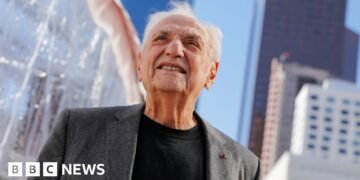























Frank Gehry, Visionary Architect, Dies at 96
Frank Gehry, one of the most innovative architects of the 20th century, has passed away at the age of 96. Renowned for his avant-garde designs and unique architectural style, Gehry’s influence reshaped not just skylines but also perceptions of modern art and architecture.
His groundbreaking work, particularly the Guggenheim Museum in Bilbao, Spain, revolutionized contemporary architecture and set a new standard for creativity and innovation in the field. Gehry’s daring approach came to symbolize a shift away from traditional architectural norms, inspiring a generation of architects and artists worldwide.
Key Developments
- Gehry’s death was confirmed by his chief of staff, Meaghan Lloyd.
- He is survived by his wife, Berta Isabel Aguilera, two daughters from his first marriage, and two sons.
- Born in Toronto in 1929, Gehry relocated to Los Angeles as a teenager to pursue architecture.
- Gehry won the prestigious Pritzker Architecture Prize in 1989 and received the Order of Canada in 2002.
- His notable works include the Jay Pritzker Pavilion in Chicago and the Louis Vuitton Foundation in Paris.
Full Report
A Legacy of Innovation
Frank Gehry’s radical approach to architecture began with his own Santa Monica residence, where he employed unconventional materials such as chain-link fencing and plywood. This experiment set the stage for his future projects, which challenged traditional symmetry and aesthetics. Gehry described his approach as a rebellion against conventional design principles, stating, “I was rebelling against everything” during an interview with The New York Times in 2012.
International Acclaim
Gehry gained global recognition with the completion of the Guggenheim Museum in Bilbao in 1997. Its striking titanium façade became an icon of modern architecture and drew millions of visitors to the city. Following this triumph, Gehry was commissioned to design landmark structures around the world, including the Gehry Tower in Germany and the Louis Vuitton Foundation in Paris. Bernard Arnault, CEO of LVMH, hailed the latter as Gehry’s most significant contribution to Paris.
A Multifaceted Artistic Vision
Gehry’s portfolio reflects an unpredictable and diverse style, evidenced by designs such as Prague’s whimsical Dancing House and the Hotel Marques in Spain, characterized by wavy, multicolored metal elements. Each structure showcases an imaginative interpretation of modern architecture, often evoking comparisons to jazz music due to their improvisational nature.
Honors and Recognition
Over his long career, Gehry received numerous accolades for his exceptional contributions to architecture. The Pritzker Architecture Prize, awarded in 1989, praised his work for its “highly refined, sophisticated and adventurous aesthetic.” He was also awarded the Presidential Medal of Freedom in 2016, recognizing his impact as a leading figure in the architectural community.
Context & Previous Events
Born in Toronto in 1929, Gehry moved to Los Angeles to study architecture. After completing his graduate studies at the Harvard Graduate School of Design, he established his own firm, beginning a career that would redefine modern architecture as known today. His work in deconstructivism has established a distinctive narrative in architectural history, leading to significant advancements in the field.