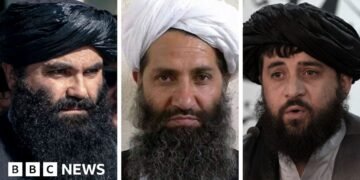

























Internal Strife Risks Taliban Unity Amid Power Struggle
The Taliban’s supreme leader, Hibatullah Akhundzada, expressed grave concerns regarding internal divisions within his regime, hinting at escalating tensions between rival factions. Recent revelations from leaked audio underscore the vulnerabilities facing the Taliban’s governance, which could be further exacerbated by competing visions for Afghanistan.
Why It Matters
The internal discord within the Taliban poses significant implications for Afghanistan’s political stability. As factions vie for influence, the potential for policy shifts—particularly concerning women’s rights and international relations—remains uncertain. This schism may impact not only governance but also the average Afghan citizen’s quality of life amid ongoing humanitarian issues.
Key Developments
-
Leaked Speech: Akhundzada warned that internal conflicts could lead to the collapse of the Islamic Emirate, a concern he voiced in a speech at a madrassa in Kandahar.
-
Two Factions: Reports identify two distinct Taliban groups: one loyal to Akhundzada advocating for a strict Islamic Emirate and another based in Kabul favoring engagement with the international community and educational rights for women.
-
Internet Shutdown: Akhundzada ordered a nationwide internet blackout in late September, which was reversed days later after significant opposition from Kabul-based ministers, illustrating a challenge to his authority.
- Consolidation of Power: Akhundzada is increasingly seen as consolidating power in Kandahar, following a trend that sidelines his former deputy ministers.
Full Report
Internal Conflict Exposed
In a recently released audio clip, Akhundzada cautioned that infighting among Taliban officials could dismantle their regime. During his speech, he emphasized the need for unity, stating that divisions could ultimately lead to their downfall. This assertion raises alarms about the Taliban’s internal cohesiveness since the regime’s assumption of power in August 2021.
The leaked audio prompted the BBC’s Afghan service to investigate the Taliban’s internal dynamics, revealing a split at the highest levels. One faction remains staunchly loyal to Akhundzada, advocating for isolationist policies, while another group, largely based in the capital, seeks a more modern approach to governance that includes potentially allowing women access to education beyond the primary level.
The Internet Debacle
Tensions reached a new height when Akhundzada ordered the shutdown of internet and phone services across Afghanistan, believing them contradictory to Islamic values. However, after three days without internet, Kabul group ministers—including figures like Sirajuddin Haqqani and Abdul Ghani Baradar—managed to persuade Prime Minister Mullah Hassan Akhund to reverse the decision, marking an unprecedented act of defiance against the supreme leader’s orders.
This incident indicates a fracture in the Taliban’s traditionally hierarchical structure, wherein obedience to leadership is a critical component of its governing ethos.
Consolidation of Authority
Akhundzada’s ascent to leadership in 2016 was characterized by a focus on consensus-building, but observers note that he has increasingly surrounded himself with hardliners in recent years. His approach has led to a pattern of sidelining influential deputies, even during pivotal negotiations with the United States that culminated in the Taliban’s return to power.
Sources suggest that while Akhundzada’s authority remains mostly unchallenged, discontent within the Kabul faction is evident. This group—comprising cabinet ministers and influential members—advocates a vision for Afghanistan that integrates aspects of international engagement rather than strict isolation.
Context & Previous Events
The Taliban regained control of Afghanistan in August 2021 after the chaotic withdrawal of U.S. forces, a development that led to thousands attempting to flee the country. Initial perceptions of the Taliban as a united front have since been tested, revealing growing rifts among leadership.
Akhundzada’s leadership style has progressively shifted away from inclusivity toward a more rigid and isolated governance, raising questions about the Taliban’s long-term stability and its ability to accommodate the diverse needs of the Afghan populace. Despite official denials of internal divisions, ongoing public statements reflect the complexities and challenges of uniting under a singular vision for the country’s future.