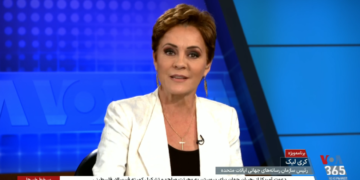























Controversy Erupts Over Kari Lake’s Role in Voice of America
In a recent broadcast, Kari Lake, who oversees the U.S. Agency for Global Media, made headlines for her enthusiastic praise of former President Trump. Critics argue that her comments may violate federal laws aimed at preserving the editorial independence of Voice of America (VOA), raising significant concerns about the agency’s integrity and purpose.
Why It Matters
The controversy surrounding Lake’s appearance spotlights ongoing debates about the use of government-funded media as platforms for political messaging. The integrity of VOA, which aims to provide unbiased information, is now under scrutiny as accusations of partisanship threaten its credibility. This situation could set a precedent for future governance of similar public entities, fundamentally affecting their operational ethics.
Key Developments
- Kari Lake praised Trump on VOA’s Persian-language service, referring to him as "the president of peace" and promoting his foreign policy claims.
- Critics, including former officials from the U.S. Agency for Global Media, assert Lake’s actions violate the editorial independence required by federal law.
- Lake has faced legal hurdles regarding her leadership role at the agency, which has led to significant layoffs and a partial reinstatement of staff due to court rulings.
- The Persian-language service of VOA, now under the guidance of Ali Javanmardi, has shifted editorial policies to favor coverage that aligns with the U.S. government’s stance and has reportedly sidelined critical voices.
- Members of Congress have responded by proposing increased funding for the U.S. Agency for Global Media, in stark contrast to the Trump administration’s budgetary requests.
Full Report
Lake’s Promotion of Trump
In a five-minute segment aired on VOA’s Persian-language service, Lake lauded Trump’s actions in the Middle East and described his presidency as one that restores global respect. Viewing this as a promotion of political propaganda, critics assert that Lake’s comments contravene the agency’s mission, which is intended to deliver impartial news.
Concerns Over Editorial Independence
The law mandates a clear separation—often referred to as a "firewall"—between political influence and editorial decisions within the U.S. Agency for Global Media. Critics argue that Lake’s prominence on the network, particularly in a partisan capacity, undermines this legal safeguard and may transform VOA into a conduit for government propaganda. David Kligerman, former general counsel for the agency, described the situation as a significant breach of journalistic ethics.
Challenges in Leadership
Lake’s legal status as deputy CEO has been contested in court. In her attempts to consolidate power, she initiated mass layoffs affecting 85% of the workforce, actions that were later legally contested and led to court orders for some staff to be reinstated. Despite her significant role, questions remain about her legal authority to lead the agency, particularly as Trump did not have the legal means to appoint her officially.
Shift in Persian-Service Editorial Direction
As Lake has prioritized the Persian-language service, concerns have arisen that editorial decisions reflect a clear bias. Reports suggest that Javanmardi, now in charge, has discouraged critical coverage of Trump and restricted guests who may oppose the administration’s views. This shift highlights a growing trend toward politically motivated editorial slants rather than balanced journalistic practice.
Legislative Backlash
In response to the evolving situation, Congress has drafted spending bills for fiscal year 2026, proposing an allotment of $643 million—substantially more than the Trump administration sought. This funding aims to ensure that VOA and other international broadcasting services can operate effectively without excessive political interference.
Context & Previous Events
Trump’s administration made significant personnel changes at the U.S. Agency for Global Media, including attempts to appoint Lake to lead VOA directly, despite legal limitations on such appointments. This series of developments has unfolded in a broader context of partisan debates over media integrity, illustrating ongoing tensions between government influence and independent journalism—a challenge critical to the future of public broadcasting in the U.S.






