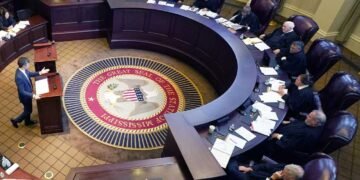























Mississippi Supreme Court to Hold Special Elections Following Map Redistricting Ruling
A judge has ordered special elections for the Mississippi Supreme Court due to constitutional violations in the electoral map used for selecting justices. This ruling comes after it was determined that the existing map, in place since 1987, dilutes the voting power of Black residents in the state.
Why It Matters
This ruling is significant as it highlights ongoing concerns around racial discrimination in electoral practices. With nearly 40% of Mississippi’s population identifying as Black, the implications of the map’s redesign could have substantial effects on representation in the state’s highest court, which has historically seen low numbers of Black justices.
Key Developments
- U.S. District Judge Sharion Aycock ruled that the current electoral map violates Section 2 of the Voting Rights Act.
- The Mississippi Legislature has until the end of its 2026 regular session to redraw the map.
- The new map will affect the special elections scheduled for November 2026.
- The Mississippi Secretary of State’s Office is appealing the ruling, while proceedings at the Fifth U.S. Circuit Court of Appeals are currently on hold pending the outcome of related Supreme Court cases.
Full Report
Ruling Overview
On Friday, the court’s directive followed an August ruling by Judge Aycock, who noted that the existing configuration splits the historically Black Delta region, leading to an underrepresentation of Black voters in the Central District. The case originated from a 2022 lawsuit filed by the American Civil Liberties Union (ACLU), precisely addressing the dilution of Black voting power under the current map arrangement.
ACLU’s Position
Ari Savitzky, a senior attorney with the ACLU’s Voting Rights Project, expressed optimism regarding the ruling, emphasizing the historical context wherein Mississippi has never had more than one Black justice serving on its nine-member court. The impending changes could pave the way for greater representation on the bench.
Legislative Response
Once the legislature finalizes the new map, Aycock indicated she would expedite any necessary actions to facilitate the special elections. However, she also stated she would wait until the map’s approval to determine which court seats would be contested in the upcoming elections.
Appeals Process
In response to the ruling, Mississippi’s Secretary of State has launched an appeal as part of a legal strategy to contest the changes mandated by Aycock. The situation remains dynamic, with the Fifth U.S. Circuit Court of Appeals pausing its review while the U.S. Supreme Court deliberates on broader implications surrounding Section 2 of the Voting Rights Act.
Context & Previous Events
The ongoing legal battle around the Mississippi electoral map reflects longstanding issues of racial inequity within the state’s political structure. Historical data indicates that only four Black individuals have held positions on the Mississippi Supreme Court, all of whom were appointed to single seats rather than being elected. Moreover, following the appointment of two justices to federal judgeships in December, Mississippi Governor Tate Reeves will appoint temporary replacements until elections can take place under the new map.






